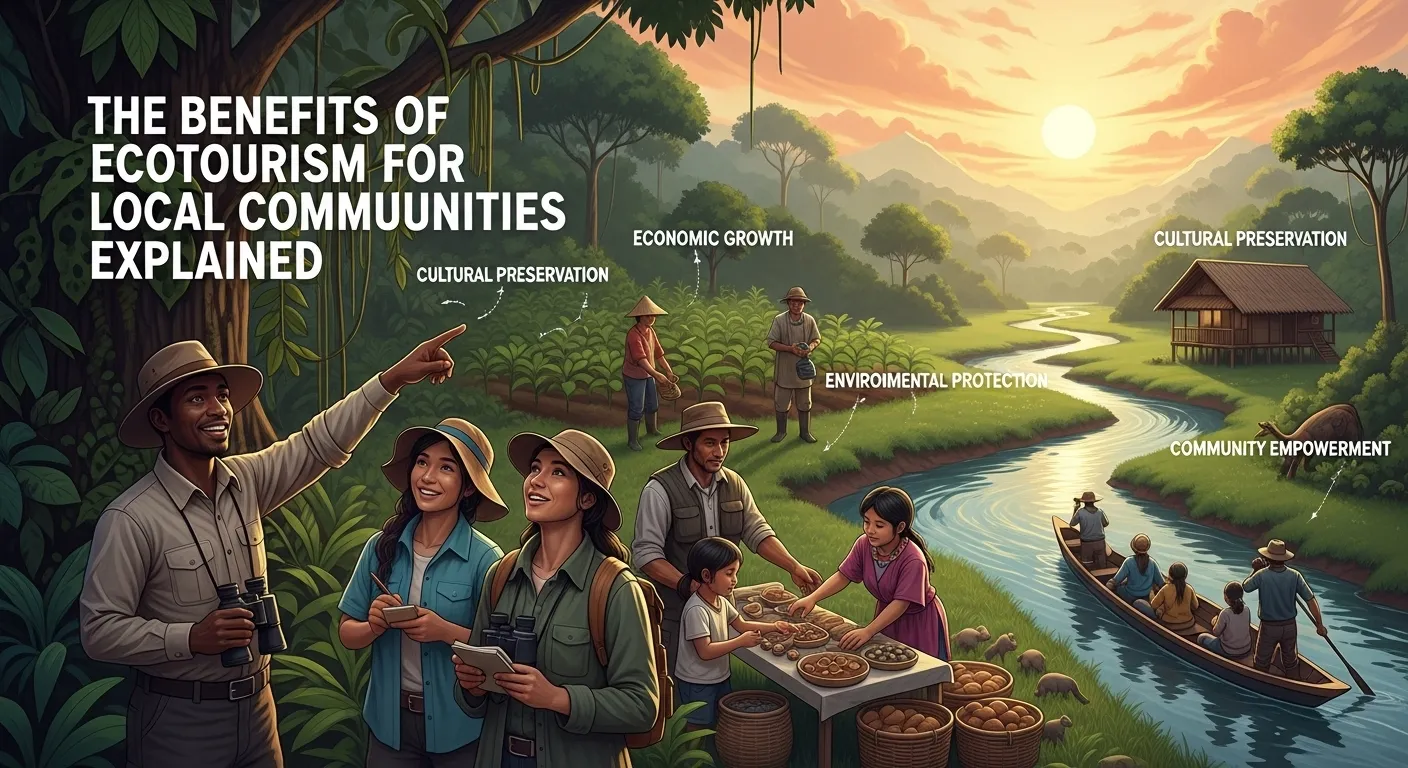
The benefits of ecotourism for local communities extend far beyond short-term income — they can transform livelihoods, strengthen cultural identity, and protect natural assets that communities depend on. This article explains how well-managed ecotourism creates sustainable economic opportunities, empowers local decision-making, and fosters environmental stewardship while addressing common challenges and best practices for long-term success. Economic Empowerment and Sustainable Livelihoods Ecotourism can be a powerful engine for economic empowerment in rural and remote communities. When visitors pay for experiences like guided nature walks, homestays, or cultural demonstrations, that money often flows directly to local families, micro-enterprises, and cooperatives. Unlike some mass tourism models where profits leave the region quickly, ecotourism—when locally managed—keeps a larger share of revenue inside the community. 1. Local job creation and entrepreneurship Local businesses emerge around ecotourism offerings: guides, guesthouse operators, artisans, food vendors, and transport services. These jobs often require low initial capital and leverage existing local skills—knowledge of wildlife, traditional crafts, or native languages. Over time, entrepreneurship can expand into complementary sectors like craft cooperatives, local food supply chains, and sustainable transport services. Small-scale enterprises typically distribute income across many households rather than concentrating profit in a few hands. This is especially important in areas with limited formal employment opportunities, where ecotourism can reduce out-migration by offering viable livelihoods at home. 2. Diversifying household income streams Ecotourism provides a supplementary source of income that can reduce dependency on resource-extractive activities (e.g., overfishing, illegal logging). Households combining agriculture with tourism services become more resilient to shocks like crop failure or commodity price drops. By diversifying income, families can invest in education, healthcare, and small-scale investments that create long-term benefits. This improved financial stability contributes to better community health and social outcomes. Local capacity-building—training in hospitality, language skills, and bookkeeping—further multiplies economic benefits. Communities that develop these skills can negotiate better partnerships with tour operators and attract higher-value visitors who appreciate authentic, well-run experiences. Environmental Conservation and Resource Management Well-designed ecotourism ties economic incentives directly to the conservation of ecosystems, creating a virtuous cycle where protecting nature becomes valuable. 2. Incentives for habitat protection When tourists come to see intact forests, coral reefs, or wildlife, communities recognize a clear link between conservation and income. This alignment encourages the establishment of community-managed reserves, anti-poaching patrols, and sustainable harvesting rules. In many cases, ecotourism revenue funds conservation patrols and monitoring equipment that would otherwise be unaffordable. Communities also adopt sustainable land-use practices—such as agroforestry and reforestation—that enhance the natural attractions tourists come to enjoy. These practices improve biodiversity, water retention, and climate resilience over the long term. 3. Environmental education and stewardship Ecotourism programs often include environmental education for both visitors and residents. Guided walks, interpretive signage, and community museums explain local ecology and the importance of conservation. This raises awareness, particularly among youth, about the value of protecting native species and ecosystems. As local people take on roles as stewards and interpreters, they develop a deeper commitment to long-term resource management. Community stewardship becomes a marketing advantage—travelers increasingly seek authentic experiences where hosts demonstrate real conservation outcomes. Cultural Preservation and Social Benefits Ecotourism can reinforce and revitalize local culture when it respects community values and gives locals control over how their culture is presented. 4. Revitalizing traditions and crafts Tourists are often attracted to authentic cultural experiences: traditional music, crafts, native cuisine, and storytelling. Selling crafts directly to visitors provides income for artisans while making cultural expressions economically viable. This can lead to the revival of craft techniques and the transmission of cultural knowledge between generations. Cultural programming—dance performances, cooking classes, or language lessons—can be designed and priced by the community, ensuring that benefits return to local custodians of tradition rather than external intermediaries. 5. Strengthening social cohesion and pride Managing ecotourism collectively (via cooperatives or community-based organizations) builds social cohesion. Shared goals around tourism income and conservation encourage collaboration, dispute resolution mechanisms, and local governance improvements. Communities report increased pride and self-esteem when they successfully host visitors and share their heritage. This recognition—combined with tangible benefits—supports community well-being and long-term preservation of cultural identity. Governance, Ownership, and Capacity Building For ecotourism to deliver consistent benefits, communities must have meaningful control over management, pricing, and planning. 6. Community ownership models Community-based tourism businesses—such as cooperatives, community trusts, or social enterprises—ensure that profits are reinvested locally. Models that allocate a percentage of tourism revenue to communal funds for education, health, and infrastructure create broad-based benefits. Ownership also means communities can set rules about visitor numbers, codes of conduct, and which cultural practices are shared. This authority helps avoid exploitation and preserves community dignity. 7. Training and institutional capacity Technical training is essential for sustainable ecotourism: business planning, marketing, quality standards, safety, and environmental monitoring. Capacity-building programs help communities negotiate fair contracts with tour operators and ensure compliance with regulations. Strong institutions—transparent financial systems, good record-keeping, and inclusive leadership—reduce risks like elite capture (where benefits concentrate among a few) and ensure equitable distribution of income. External NGOs, governments, and private partners can play constructive roles as long as they prioritize local leadership. Challenges, Risks, and Mitigation Strategies Ecotourism is not a silver bullet; it carries potential risks if poorly managed. Recognizing these risks and deploying mitigation strategies is essential for long-term success. 8. Over-tourism and environmental degradation Even ecotourism can damage fragile ecosystems if visitor numbers exceed carrying capacity. Trampling, litter, disturbance to wildlife, and pressure on water and waste systems are real concerns. Communities should establish limits on visitor numbers, create seasonal access rules, and invest in low-impact infrastructure. Regular monitoring and adaptive management—adjusting rules based on ecological indicators—help maintain a balance between income and conservation. 9. Cultural commodification and loss of authenticity When cultural practices are staged purely for tourists, communities risk commodifying traditions. The solution is community control over how culture is shared, clear benefit-sharing agreements, and opportunities for genuine inter-cultural exchange rather than scripted performances. Education for visitors—about respectful engagement and the meaning behind cultural practices—fosters deeper appreciation and reduces exploitative behaviors. 10. Economic

Long Term Effects of Soil Erosion: Risks and Solutions
Understanding the long term effects of soil erosion is essential for farmers, planners, policymakers, and anyone who depends on clean water and reliable food supplies—which is to say, all of us. Soil erosion is not just a seasonal nuisance; it is a slow-moving crisis that accumulates over decades, irreversibly stripping landscapes of fertility, biodiversity, and resilience. This article explains the risks and the solutions using the latest evidence and best practices so you can make decisions that stand the test of time. H2: What Soil Erosion Is—and Why It Keeps Getting WorseSoil erosion is the detachment and movement of soil particles by water, wind, or tillage. While a small amount of erosion is natural, human activity has amplified the rate and scale, converting healthy topsoil into sediment that clogs rivers, reservoirs, and coastal zones. The result is a long-term decline in soil function, productivity, and ecosystem stability. Globally, estimates suggest billions of tons of soil are lost each year, with losses concentrated on croplands and overgrazed rangelands. The most damaging losses occur from the top few inches of soil, where organic matter, nutrients, microbes, and fine aggregates provide most of the biological and agronomic value. Once that layer is gone, recovery can take centuries—if it happens at all. The persistence of erosion stems from structural pressures: expanding food demand, extreme rainfall and drought cycles, and incentives that reward short-term yield over long-term soil health. This section explains the processes that drive erosion, setting up the deeper dive into impacts and solutions. H3: 1) Primary Drivers: Climate, Land Use, and ManagementErosion intensifies when climatic stress meets vulnerable land cover. More frequent high-intensity storms increase runoff, while longer dry spells leave bare soil more exposed to wind. Land clearing, overgrazing, and frequent tillage reduce protective cover and break soil aggregates, creating conditions where raindrops and wind shear can detach particles more easily. Management practices often amplify those forces. Conventional tillage pulverizes soil, reducing infiltration and increasing surface sealing; steep-slope farming without terraces accelerates downslope soil transport; and poor road drainage channels runoff into gullies. In many regions, the removal of hedgerows and riparian vegetation has eliminated critical landscape buffers that once trapped sediment and slowed water. H3: 2) Erosion Pathways: Splash, Sheet, Rill, Gully, and WindErosion begins with splash impact when raindrops hit bare soil, dislodging particles. As water flows, sheet erosion skims soil from broad areas, then concentrates into rills (small channels) and eventually gullies that can slice through fields and hillsides. Each step increases the energy and volume of sediment transport. Wind erosion follows a similar energy gradient. When surface cover is sparse and soil is dry and fine-textured, wind can move particles by saltation (bouncing) and suspension (airborne dust), stripping organic matter and leaving behind coarser, less fertile material. Over time, both water and wind erosion coarsen the soil, reduce water-holding capacity, and leave hardpans or crusts that further reduce infiltration. H2: The Long-Term Ecological and Agricultural ImpactsThe long-term impacts of erosion accumulate silently. Productivity declines slowly at first, then more steeply as topsoil thresholds are crossed. Ecosystem services—from water filtration to pollinator habitat—contract. These changes are expensive to reverse and some are functionally irreversible on human timescales. Agriculture bears the brunt. Soil fertility is not just a bag of nutrients; it’s a living system that supplies moisture buffering, nutrient cycling, and disease suppression. Erosion undermines all three. Farther downstream, the consequences spread to fisheries, reservoirs, and municipalities that must treat sediment-laden water, shifting costs from farms to public budgets. Ecologically, erosion fragments habitats and alters stream morphology. Sediment-sensitive species decline, while opportunistic and invasive species gain ground. The cumulative effect is a loss of landscape resilience to climate extremes, pests, and wildfire. H3: 1) Declining Soil Fertility and Crop YieldsTopsoil erosion removes the richest fraction of soil organic carbon (SOC), clay, and silt—components that store nutrients and water. As SOC declines, soils lose structure (aggregate stability), infiltration falls, and plants face more drought stress even when rainfall totals haven’t changed. Farmers often respond with more fertilizer and irrigation, raising costs and environmental risk. Over decades, yield trends can flatten or reverse, especially on slopes. Research and farm records commonly show higher inter-annual yield variability on eroded fields because the buffering capacity is reduced. This volatility matters as climate extremes become more frequent, threatening long-term farm viability. H3: 2) Biodiversity and Soil Life LossErosion simplifies soil habitats, reducing pores and microaggregates that shelter microbial and mesofaunal communities. With fewer niches and less organic matter, beneficial organisms that drive nutrient cycling and disease suppression decline. Aboveground biodiversity also suffers when hedgerows and field margins are removed, reducing corridors for pollinators and natural enemies of pests. Over time, landscapes become more homogeneous and less resilient. Local extinctions of sensitive species can cascade, eroding ecosystem functions like pollination, predation, and decomposition. Rebuilding those functions requires both soil restoration and habitat reconnection. H3: 3) Water Quality Degradation and SedimentationSediment is a leading cause of impaired waters. As eroded particles enter streams, they carry attached nutrients and contaminants (phosphorus, pesticides, heavy metals). This can produce algal blooms, hypoxia, and drinking water challenges. Reservoirs lose storage capacity as sediment accumulates, shortening infrastructure lifespans and increasing dredging needs. Once sediments settle in riverbeds and deltas, they alter flow patterns, increase flood risk, and degrade spawning grounds. The costs are borne by fisheries, utilities, and communities far from the original erosion source, illustrating why erosion is a basin-wide problem requiring basin-wide solutions. H2: Climate Feedback Loops and Carbon AccountingErosion interacts with climate change in both directions. More intense rainfall and drought cycles accelerate soil loss, while erosion-driven carbon emissions feed back into the climate system. Long-term mitigation must therefore address soil as a critical carbon pool. When topsoil is lost, the carbon that once was stored in stable aggregates can be oxidized to CO2. Dust from wind erosion can also darken snow and ice surfaces, lowering albedo and amplifying regional warming. Conversely, restoring soil cover and structure increases surface reflectivity and cools local microclimates, improving moisture