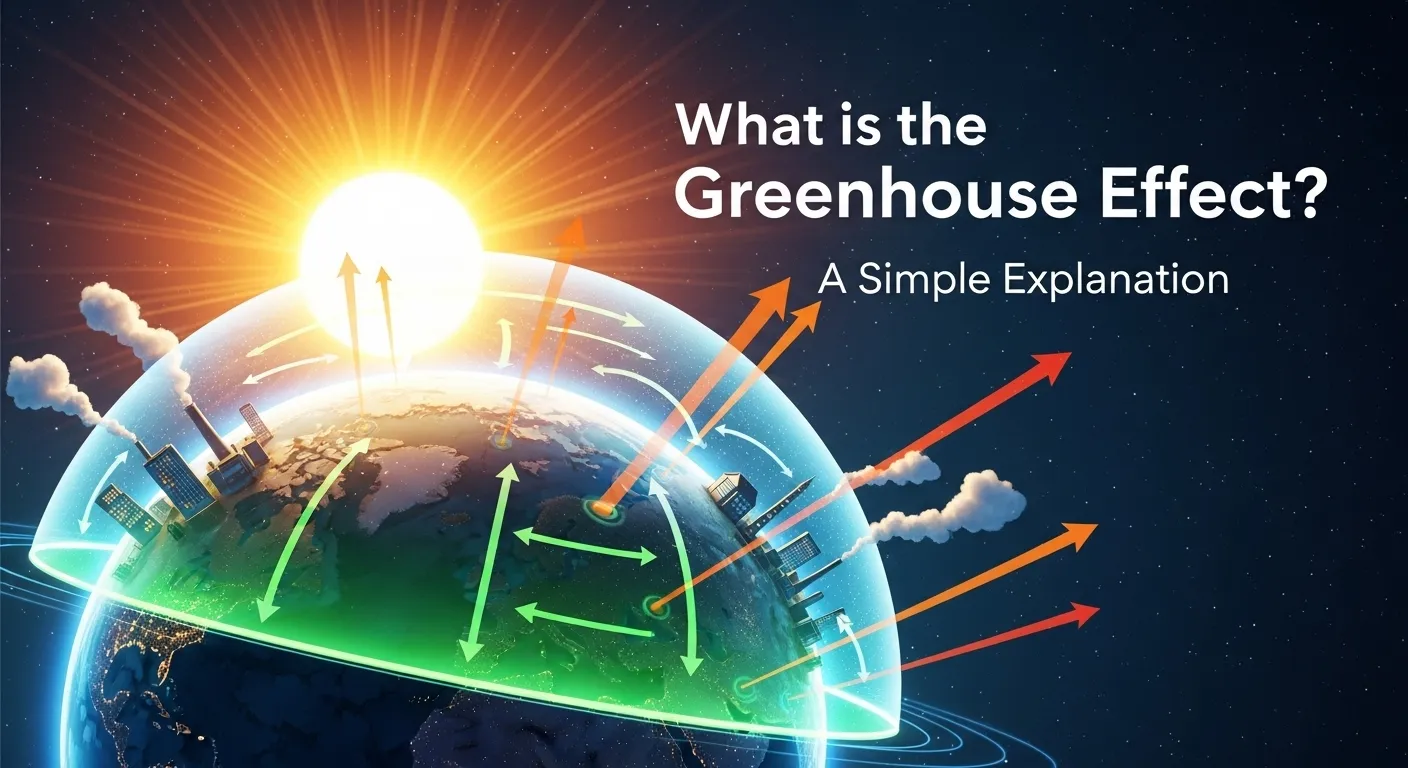
Have you ever gotten into a car that’s been sitting in the sun on a hot day? The inside is significantly warmer than the air outside. This happens because the sun's rays enter through the windows, but the heat they generate gets trapped inside, unable to escape easily. In a nutshell, you've just experienced a small-scale version of the Earth's greenhouse effect. It's a fundamental process that makes our planet habitable, but it's also a term at the center of conversations about climate change. If you're looking for what is the greenhouse effect explained simply, you've come to the right place. This article will break down this crucial concept, from its natural function to the human impact that's turning up the planet's thermostat. The Natural Greenhouse Effect: Earth's Essential Blanket The greenhouse effect is not, by its nature, a bad thing. In fact, it's an absolutely essential natural process that has kept the Earth's temperature at a comfortable average of about 15°C (59°F). Without this natural warming mechanism, the planet's surface would be a frigid, inhospitable -18°C (0°F), making it impossible for life as we know it to thrive. Think of the natural greenhouse effect as Earth's invisible, life-sustaining blanket, perfectly calibrated to keep us warm enough but not too hot. The process works in a few simple steps. First, the sun emits solar radiation that travels through space and reaches our atmosphere. A portion of this energy is reflected back into space by clouds and the Earth's surface (like ice caps), but the majority passes through the atmosphere and is absorbed by the land and oceans, warming the planet. As the Earth's surface heats up, it radiates some of this energy back outwards in the form of infrared radiation, which we feel as heat. This is where certain gases in our atmosphere, known as greenhouse gases, play their crucial role. Instead of allowing all this outgoing heat to escape into space, greenhouse gases absorb it and re-radiate it in all directions, including back down towards the Earth's surface. This trapping of heat is what creates the warming "greenhouse effect." The primary natural greenhouse gases include water vapor (H₂O), carbon dioxide (CO₂), methane (CH₄), and nitrous oxide (N₂O). They act like the glass of a greenhouse, letting sunlight in while preventing a significant amount of heat from getting out, maintaining a stable and livable temperature for ecosystems, plants, and animals to flourish. The Main Greenhouse Gases: A Closer Look at the Key Players While many gases make up our atmosphere (mostly nitrogen and oxygen), only a small fraction are greenhouse gases. However, their small concentration belies their powerful impact on the planet's climate. These gases are defined by their ability to absorb and emit infrared radiation. Understanding the main players is crucial to grasping the full picture of the greenhouse effect, especially the changes we are currently witnessing. Each gas has a different heat-trapping ability and a different atmospheric lifetime, which are combined into a metric called the Global Warming Potential (GWP). It's important to distinguish between naturally occurring greenhouse gases and those amplified or solely produced by human activities. For millennia, the concentration of these gases was in a delicate balance, regulated by natural cycles like volcanic eruptions, animal respiration, and plant photosynthesis. However, since the Industrial Revolution began around the late 18th century, human activities have drastically increased the concentration of these gases, thickening the Earth's "blanket" and disrupting this delicate balance. Let's break down the most significant greenhouse gases. #### Carbon Dioxide (CO₂) Carbon dioxide is the most significant long-lived greenhouse gas in the atmosphere, primarily because of its sheer volume and persistence. Naturally, CO₂ is exchanged between the atmosphere, oceans, and land through processes like photosynthesis (where plants absorb it) and respiration (where animals release it). However, human activities have become the dominant source of new CO₂ emissions. The burning of fossil fuels—coal, oil, and natural gas—for electricity, transportation, and industry is the largest contributor. Furthermore, deforestation plays a dual negative role. When forests are cleared and burned, the vast amounts of carbon stored in the trees are released into the atmosphere as CO₂. At the same time, we lose a critical natural "carbon sink" that would otherwise be absorbing CO₂ from the atmosphere. Once released, CO₂ can remain in the atmosphere for hundreds to thousands of years, meaning the emissions we produce today will continue to warm the planet for many generations to come. #### Methane (CH₄) Methane is the second most significant greenhouse gas resulting from human activities. On a molecule-for-molecule basis, methane is much more potent at trapping heat than CO₂—over 25 times more effective over a 100-year period. However, it has a much shorter atmospheric lifetime of about 12 years. Natural sources of methane include wetlands and termites, but human-linked sources now account for the majority of emissions. Key anthropogenic sources of methane include agriculture, particularly from livestock digestion (e.g., cow burps) and rice cultivation in flooded paddies. The energy sector is another major contributor, with methane leaking during the extraction, processing, and transportation of natural gas and coal. Decomposing organic waste in landfills also produces significant amounts of methane. Reducing methane emissions could provide a relatively quick, short-term benefit in the fight against global warming due to its shorter lifespan in the atmosphere. #### Nitrous Oxide (N₂O) Nitrous oxide is another powerful greenhouse gas. While its concentration in the atmosphere is lower than CO₂ or methane, it is extremely effective at trapping heat—nearly 300 times more potent than CO₂ over a century. It also has a long atmospheric lifetime of around 114 years. Natural sources include bacteria in soils and the oceans as part of the Earth’s nitrogen cycle. Human activities, however, have significantly boosted its concentration. The largest source is agriculture, particularly the use of synthetic nitrogen fertilizers on soils. When excess fertilizer is applied, soil microbes convert it into nitrous oxide, which is then released into the atmosphere. Other sources include industrial processes, the combustion of fossil fuels,