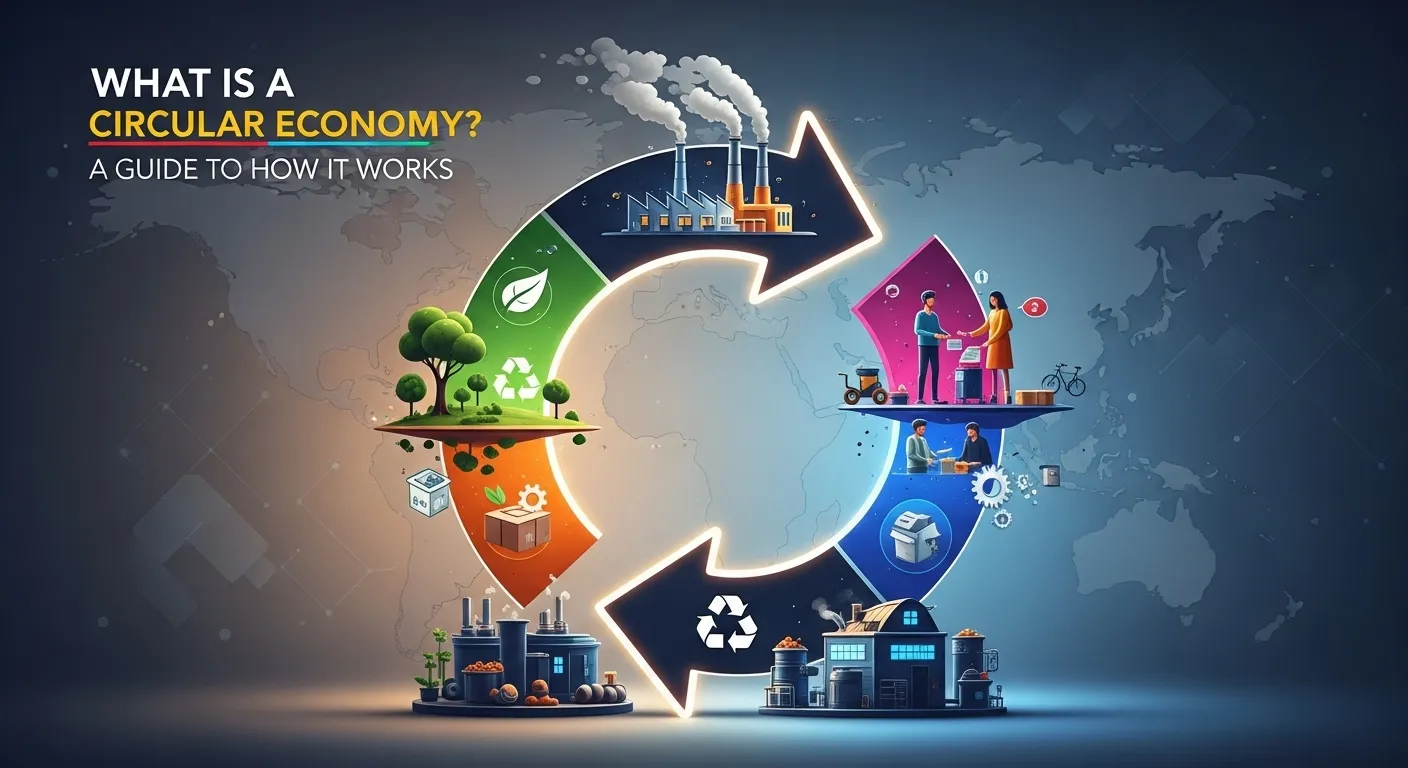
Our modern world is built on a simple, yet profoundly flawed, system: we take resources from the earth, make them into products, and then dispose of them once we're done. This linear "take-make-dispose" model has fueled incredible growth, but it's coming at an unsustainable cost to our planet and our economy. As resources dwindle and waste piles up, a powerful alternative is gaining momentum, one that a ims to redesign our entire economic system from the ground up. This guide will explore in-depth what is a circular economy and how does it work, offering a blueprint for a more resilient, regenerative, and prosperous future. The Linear Economy: Understanding the Problem For centuries, our global economy has operated on a linear model. This system is straightforward: we extract raw materials, manufacture products, sell them to consumers, and then, after a period of use (which is often becoming shorter and shorter), the products are thrown away as waste. Think of the single-use coffee cup, the fast-fashion t-shirt worn only a few times, or the smartphone that's rendered obsolete by a new model in just two years. This is the linear economy in action, a one-way street from extraction to landfill. The environmental consequences of this model are staggering. It drives massive resource depletion, as we continuously mine virgin materials instead of reusing what we already have. It generates immense pollution at every stage, from the carbon emissions of extraction and manufacturing to the toxic leachate from landfills and the plastic choking our oceans. The "dispose" phase has created a global waste crisis, with mountains of trash that fail to decompose, releasing greenhouse gases and contaminating soil and water systems. In essence, the linear economy treats our planet's finite resources as if they were infinite. From an economic perspective, the linear model is also incredibly wasteful. When a product is thrown away, all the value embedded in it—the materials, the labor, the energy, the capital—is lost forever. This creates a system that is highly vulnerable to resource price volatility and supply chain disruptions. Businesses are constantly at the mercy of fluctuating commodity markets. Furthermore, it represents a colossal missed opportunity for innovation, job creation, and new revenue streams that could be unlocked by capturing the value of so-called "waste." The circular economy offers a radical and logical alternative to the linear model. At its core, it is a new economic framework that is restorative and regenerative by design. Instead of a straight line ending in waste, it envisions a continuous loop where resources are kept in use for as long as possible, their maximum value is extracted, and materials are recovered and regenerated at the end of their service life. It's about fundamentally rethinking how we design, produce, and consume everything, shifting our perspective from "cradle-to-grave" to "cradle-to-cradle." This paradigm shift is guided by three core principles, famously articulated by the Ellen MacArthur Foundation, a leading authority on the subject. These principles are not just about better waste management; they are a blueprint for systemic change, aiming to build economic, natural, and social capital. They force us to move beyond the shallow idea of just recycling more and toward a deeper re-imagination of our entire industrial and biological systems. Implementing these principles requires a profound change in mindset. It means moving from a culture of consumption to a culture of use. Products are no longer just things to be owned and discarded but are seen as vehicles for delivering a service. A company might sell "lighting" instead of light bulbs, or "mobility" instead of cars. This service-based approach incentivizes durability, repairability, and ultimate recovery, as the manufacturer retains ownership and responsibility for the product throughout its life. Design Out Waste and Pollution The most critical principle of the circular economy is to eliminate the very concepts of waste and pollution from the beginning. This isn't about dealing with waste after it's created; it's about proactive design that prevents it from ever arising. In a circular system, waste is a design flaw. Products are intentionally designed for durability, longevity, easy disassembly, and repair. Materials are chosen carefully, avoiding toxic substances that could harm the environment or prevent materials from being safely returned to the system. Consider the modern smartphone. Many are glued together, making battery replacement or screen repair difficult and expensive, effectively encouraging consumers to buy a new device. In a circular design, that same smartphone would be modular. The battery, camera, and screen could be easily swapped out and upgraded by the user. The materials used would be standardized and non-toxic, allowing them to be easily recovered and channeled back into manufacturing new components. This design-led approach is the first and most important step in closing the loop. Keep Products and Materials in Use The second principle focuses on creating systems to keep products and materials circulating at their highest possible value. This involves a hierarchy of "loops" that prioritize value preservation. The tightest, most valuable loop is maintenance and repair, which extends a product's life in its original form. The next loop is reuse, where a product is passed on to a new user without significant modification. Further out are refurbishing (improving a product aesthetically and functionally) and remanufacturing (disassembling a product and rebuilding it with reused, repaired, and new parts). Recycling is the final loop in this hierarchy and is considered a last resort for materials that cannot be kept in the inner loops. While far better than landfill, recycling often results in a loss of material quality (down-cycling) and requires significant energy. For example, reusing a glass bottle preserves 100% of its value and structure with minimal energy. Remanufacturing an engine block retains the core value and saves enormous amounts of energy compared to melting it down (recycling) and casting a new one. The goal is to keep products and components in the tightest, most value-retentive loops for as long as possible. Regenerate Natural Systems This third principle distinguishes the circular economy from a purely industrial efficiency model.