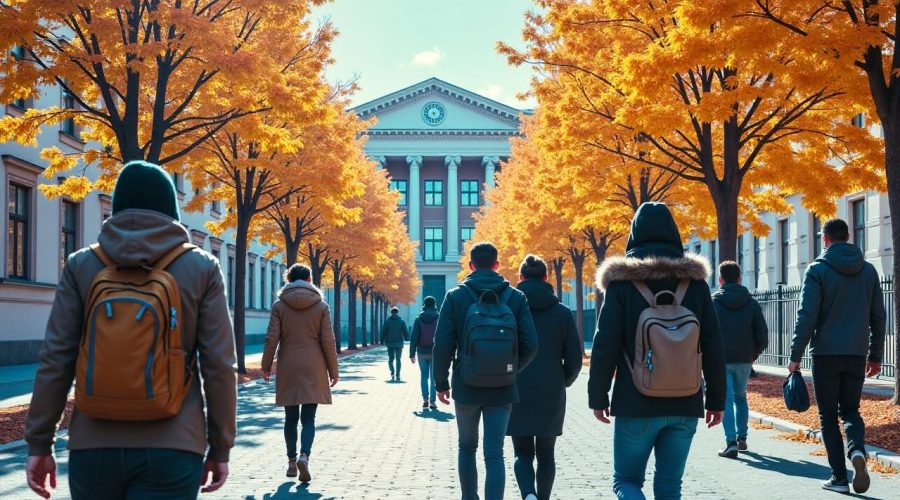
The College Scam That Promised Students Fleeing War a New Life in Finland
The college scam that promised students – In April 2025, Finland’s Border Guard launched a sweeping investigation into an education agency that had promised to help hundreds of Burmese students gain access to vocational schools in the Nordic nation. The agency, Brighter Future Way (BFW), had been operating out of Mae Sot, a Thai border town, and had lured refugees with the promise of a secure future. Among those affected was *Ma Naw Phaw, a 19-year-old who had left her war-torn homeland in search of stability.
A Dream Cut Short
Ma Naw Phaw had been living as a refugee in Mae Sot since the military coup in Myanmar in February 2021. The overthrow of the democratically elected government disrupted education, forcing many students to abandon junta-controlled schools. For Ma Naw Phaw, the turning point came when she joined a refugee high school in the town. It was there she learned of BFW’s services, which offered pathways to study in Finland. “I just needed a degree to find a good job and support my family,” she said, her voice steady despite the disappointment ahead.
“It didn’t matter what I studied,” the 19-year-old says. “I just knew I needed a degree to find a good job and earn a decent salary to support my family.”
She paid around 10,000 euros—equivalent to over $11,500 or £8,600—to BFW, which claimed it would cover Finnish language classes, an application to a vocational school, and a residence permit. The cost was significant for her family, taking nearly a year to raise the funds. Yet they believed it was worth the effort, hoping for a fresh start in a country they viewed as a beacon of opportunity.
The Agency’s Collapse
Months later, Ma Naw Phaw’s hopes crumbled when Finland rejected her residence permit application. BFW had assured her the process would be straightforward, but the rejection left her with no recourse. She sought a refund, only to find the agency unreachable. Soon after, the founder of BFW, Min Min Soe Shwe, was arrested in Finland, raising questions about the agency’s legitimacy. A co-founder based in Thailand, Phitak Pakay, told the BBC that the company had “lost contact” with Min Min and would soon stop operations, citing the dormitory’s emptiness as evidence.
“There are no students left in the dormitory,” Phitak Pakay said, revealing the agency’s sudden halt. “We have to close down now.”
Finland’s Border Guard confirmed the investigation, which targeted BFW for allegedly charging excessive fees under the pretense of arranging study places, residence permits, and language exams. “At least some of these students may have been overcharged,” the statement read, adding that many were left in financial debt. Juho Sillanpää, the lead investigator, warned of the risks faced by those who had trusted the agency. “This could leave students in a vulnerable position, making them targets for further exploitation,” he said.
The Broader Scheme
BFW was not an isolated case. In recent years, third-party agencies have emerged to help non-EU students enroll in Finnish educational institutions. These “commissioners” streamline the process, tailoring programs to meet the needs of their recruits. While some students succeeded, others were left stranded. The BBC’s analysis of interviews with six affected individuals, along with records from a Finnish vocational school, paints a picture of a system that promised more than it delivered.
According to BFW’s website, the agency specialized in language training and student recruitment for Myanmar nationals. Its services included preparing candidates for vocational courses in nursing, property maintenance, and catering. The company’s registered offices spanned three countries, including Myanmar, Thailand, and Finland, and its mission was described as “supporting our students every step of the way.” Yet, the reality for many was far different. Ma Naw Phaw’s experience mirrored that of others who had paid hefty fees only to face rejection or confusion.
Survivors and Scammers
Despite the setbacks, not all students were left without hope. *Ko Myo, a 26-year-old who had enrolled through BFW, now works in a nursing home after completing a vocational course. He said the agency allowed him to delay some payments, but he remained skeptical about the full cost. “They told me everything would be handled, but I’m not sure if I got the best deal,” he admitted.
“The agency allowed me to defer some payments,” Ko Myo said. “But I’m still unsure if I got the best deal.”
BFW’s legal team and family members declined to comment when contacted by the BBC. Meanwhile, the investigation continues, with authorities probing whether the agency engaged in aggravated extortion. Sillanpää noted that while past cases of educational fraud had been smaller in scale, this incident involved a larger cohort of students, raising concerns about systemic deception.
The Cost of Hope
For Ma Naw Phaw and her peers, the scam was more than a financial loss—it was a shattered dream. The vocational school in Finland, once a symbol of a better life, now felt like a distant memory. “I thought I could finally build something for my family,” she said, her words carrying a mix of regret and determination. The agency had promised a pathway to opportunity, but many found themselves trapped in a cycle of debt and uncertainty.
Analysts suggest that BFW’s rise was tied to the growing number of Burmese refugees seeking education abroad. With limited options in Thailand, where many were displaced, agencies like BFW became a lifeline. However, their methods often lacked transparency, and some students were unaware of the hidden costs. The Finnish government, while supportive of international education, now faces scrutiny over its role in vetting these third-party organizers.
As the investigation unfolds, questions remain about how many students were affected and whether BFW’s practices were widespread. The BBC’s findings indicate that the agency’s operations spanned from 2022 to 2025, during which it helped over 350 Burmese students. For those who had already moved to Finland, the fallout includes not just financial strain but also emotional distress. “I feel like I was sold a promise I couldn’t keep,” Ma Naw Phaw said, echoing the sentiments of many who had entrusted their futures to the agency.
With the founder of BFW now in custody, the focus shifts to the legal and financial consequences for the victims. Authorities are working to trace the agency’s assets and determine the extent of its fraud. For now, the story of Ma Naw Phaw and others serves as a cautionary tale about the risks of chasing opportunities in uncertain times. As the investigation progresses, the hope is that those who fell prey to the scam will find justice and a way to rebuild their lives. But for now, the dream of a new beginning in Finland feels more like a distant promise than a reality.