
A free Iran is their shared dream. But the diaspora remains torn on the best path forward.
A Free Iran is Their Shared Dream. But the Diaspora Remains Torn on the Best Path Forward
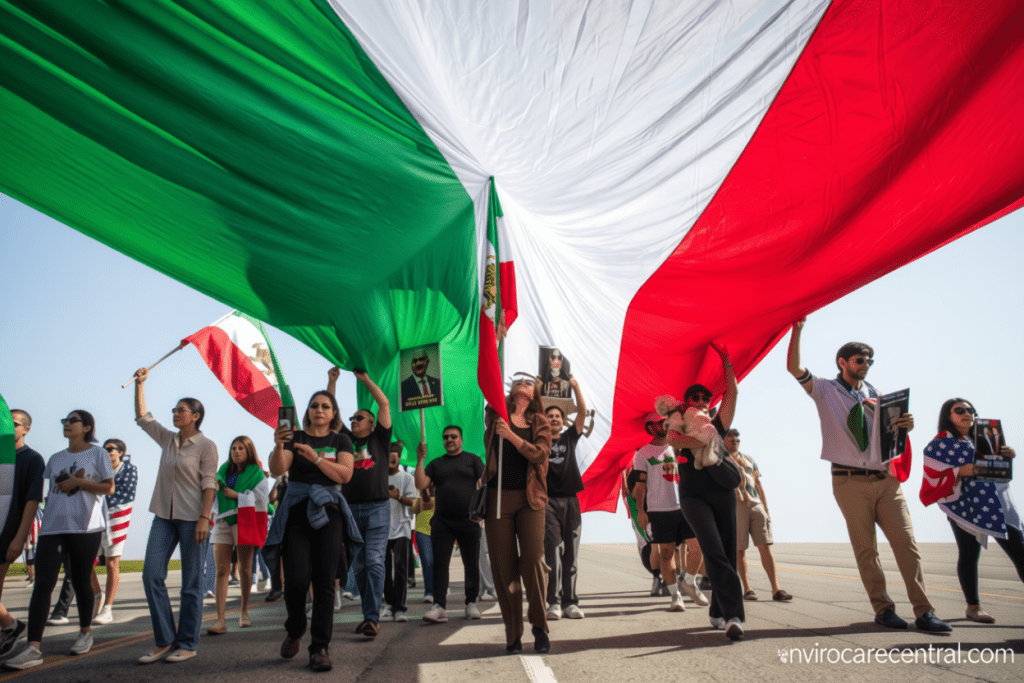
Los Angeles has become a microcosm of conflicting sentiments within the Iranian diaspora, as two contrasting demonstrations unfolded recently. In one corner, a crowd gathered near City Hall to voice opposition to an unsanctioned war, chanting slogans like “Stop the war in Iran” and “We the people don’t want war.” In another, the same community celebrated the potential end of theocratic rule, with participants waving American, Israeli, and Iranian flags, dancing to upbeat music, and expressing hope that the assassination of Ayatollah Ali Khamenei would spark regime change.
The division among Iranian Americans reflects the tension within the community as Middle East violence intensifies. Families who fled Iran after the 1979 Islamic Revolution now find themselves split between those who see war as a necessary step to dismantle the regime and those who fear its consequences. “Some are so frustrated with the current system that they’re willing to sacrifice parts of the country to destroy it,” noted Abbas Milani, director of Iranian studies at Stanford University. “Others prioritize peace, even if it means tolerating the regime for now.”
Online Tensions Escalate
Since the U.S.-Israeli strikes, online discourse among Iranians has grown more polarized. Supporters of military action are increasingly labeled “Zionists,” a term that has evolved into a derogatory reference to Jews following the Hamas attacks on Israel in October 2023. Meanwhile, anti-war advocates are accused of aligning with the regime. This polarization has deepened as the government imposes an internet blackout, isolating families and hindering communication.
Leadership Debate
As the conflict continues, the question of who will lead Iran in its aftermath remains unresolved. Some advocate for Reza Pahlavi, the son of the last shah, while others remain skeptical of his ability to govern without ties to the monarchy. Rumors suggest Mojtaba Khamenei, the supreme leader’s son, could take over, adding uncertainty to the political landscape. Analysts warn that the Islamic Revolutionary Guard Corps is likely to consolidate power if it endures the current crisis.
Nowruz, the Persian New Year, looms as a time for renewal, but its celebrations now carry undercurrents of anxiety. The death toll in Iran has surged, and the destruction of cultural landmarks has sparked mixed reactions. “The suffering today is worse than generations of repression,” said Ara Torosian, a Los Angeles-based pastor who fled Iran in 2010. “But for those who opposed the regime, this pain is a form of justice.”
Despite these divides, the dream of a free Iran unites many. However, the path to achieving it remains contentious. A recent NBC News poll revealed that 54% of American voters disapprove of Trump’s handling of the situation, echoing the split within the Iranian diaspora. Last year’s survey by the National Iranian American Council and YouGov showed 53% of Iranian Americans opposed U.S. military intervention, with a new poll set to release updated findings next week.
“We are not a monolith,” wrote the Iranian Diaspora Collective on Instagram, a platform with over 81,000 followers. “Millions of people will never share the same ideology or identity, and that plurality is the strength of any free society.” As the situation evolves, the diaspora’s unity may be tested by the lingering scars of war and the uncertainty of what comes next.
