
Taiwan opposition leader visits China for expected meeting with Xi Jinping
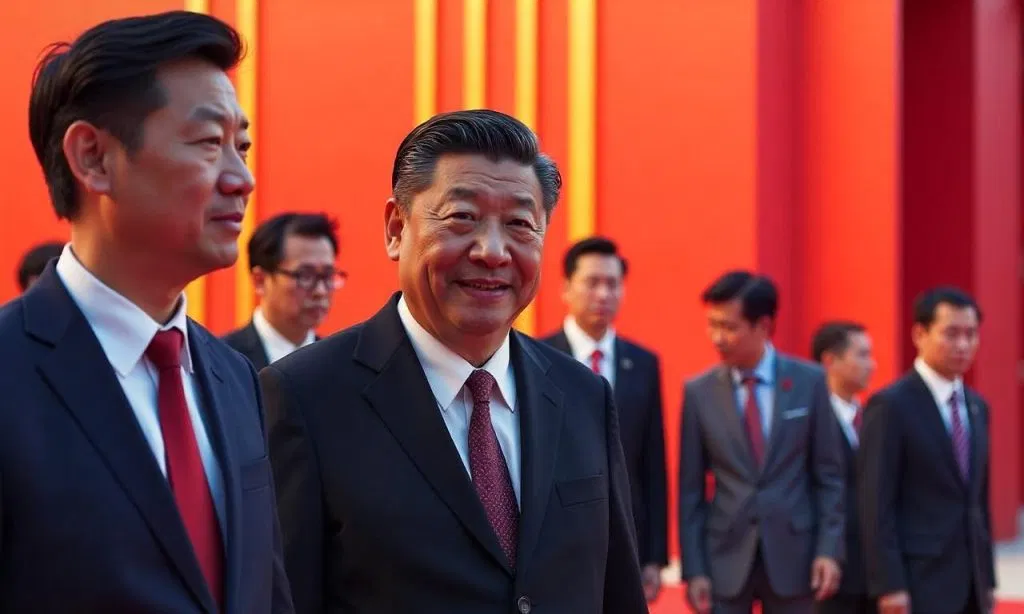
Taiwan Opposition Leader’s China Visit Sparks Debate
Taiwan’s primary opposition party has sent its leader to China, setting up a significant encounter with President Xi Jinping. Cheng Li-wun, who assumed the role of KMT chairperson last year, expressed her acceptance of Xi’s invitation to visit, emphasizing her goal of acting as a “bridge for peace.” The planned meeting is part of a six-day itinerary that includes stops in Shanghai, Nanjing, and Beijing. This marks the first time an incumbent KMT chief has traveled to China in ten years.
Beijing suspended certain ties with Taiwan following the DPP’s Tsai Ing-wen taking office in May 2016, citing her rejection of the single Chinese nation concept. China perceives Taiwan as a breakaway province destined to join the country, and has not ruled out military action to achieve this. Meanwhile, many in Taiwan identify as a sovereign state, yet most support maintaining the current status quo—neither seeking formal independence nor unification with China.
DPP Criticizes Opposition Leader’s Trip
Taiwan’s ruling party, the DPP, voiced concerns over Cheng’s visit, calling her “subservient” to Beijing. They argued that her trip would be “completely controlled” by the Communist Party, and accused China of being the “main culprit in disrupting regional peace.” This includes China’s ongoing deployment of war planes and naval vessels near Taiwan. Premier Cho Jung-tai stated the government would closely track Cheng’s activities during her stay.
Cheng’s willingness to engage with Beijing contrasts with her predecessors’ more cautious approach to cross-strait relations, according to analysts. Her visit occurs amid rising doubts about the U.S. in Taiwan, largely due to Trump’s conflicting signals on Taiwan policy and the Middle East conflict. “Cheng sees this as an opportunity to position herself as the political leader capable of maintaining cross-strait exchange and potentially easing tensions,” noted William Yang, a North East Asia analyst at the International Crisis Group.
Strategic Implications of the Visit
The U.S. maintains formal relations with Beijing rather than Taiwan, but has long been its largest arms supplier. Recently, Trump suggested Taiwan should compensate the U.S. for defending it against China. A bipartisan U.S. delegation visited Taipei last week, urging lawmakers to approve a $40bn special defence spending bill, which is currently blocked in the opposition-led parliament.
“Beijing wants a cordial meeting with Taiwan’s opposition to undermine the argument for US-Taiwan defence cooperation,” said Wen-ti Sung of the Australia National University’s Taiwan Centre. “This allows China to focus on cutting business deals with the U.S. during Trump’s visit, rather than addressing cross-strait issues.”
Cheng’s trip could bolster her political standing ahead of local elections later this year. Despite beginning her career as a pro-independence advocate, she has increasingly positioned herself as a peace-builder. “She is trying to thread a needle between the U.S. and China… to enhance her leadership stature while highlighting Taiwan President Lai Ching-te’s failure to engage with Beijing,” Yang explained.
“Many see Cheng as a fair-weather politician, an opportunist with little principle, and someone who prioritizes her own position over broader goals,” remarked Chong Ja-Ian of the National University of Singapore. “That is why polls show limited confidence in her. ‘Who this benefits, and how much, are the bigger questions,’ Chong added.
