
Ecotourism vs. Sustainable Tourism: What’s the Difference?
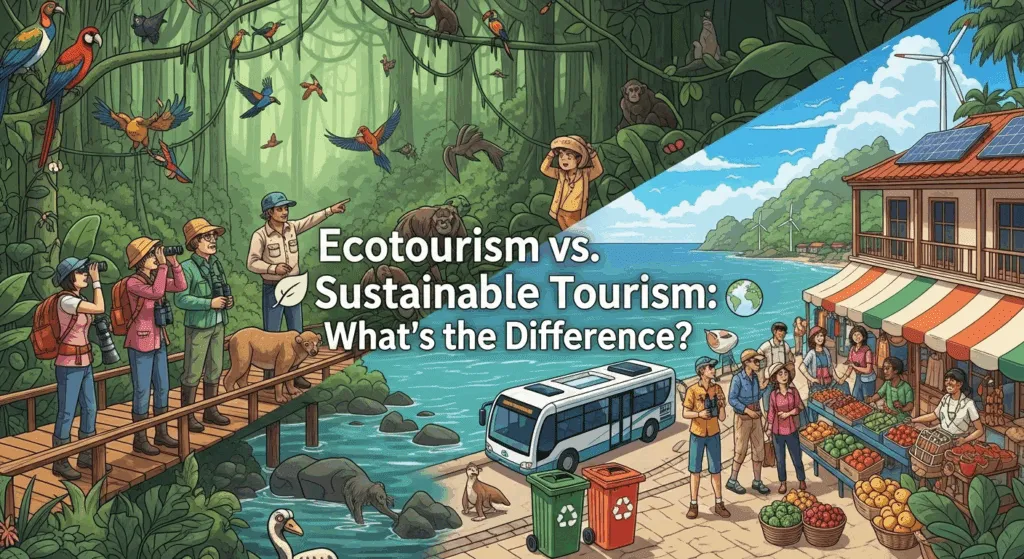
As the world becomes more interconnected and travel more accessible, a growing consciência is emerging among travelers. We are no longer content to simply visit a destination; we want to ensure our presence does more good than harm. This has led to the rise of terms like "ecotourism" and "sustainable tourism," often used interchangeably in travel blogs and marketing materials. However, while they are closely related and share a common goal of making travel better, they are not the same. Understanding the nuances in the ecotourism vs. sustainable tourism debate is crucial for anyone who wants to travel responsibly and make informed choices. This guide will demystify these concepts, offering clear definitions, practical examples, and actionable advice to help you become a more conscious globetrotter.
The modern traveler is faced with a dizzying array of choices, and the language of "ethical travel" can sometimes add to the confusion. Are you looking for an "eco-lodge" or a "sustainable hotel"? Is that jungle trek an example of ecotourism, or is it just nature-based tourism? The distinction is more than just semantics; it shapes the very impact of your journey on a destination's environment, culture, and economy. At its core, the difference lies in scope and focus. Sustainable tourism is the overarching philosophy, a broad framework that can apply to any type of travel, anywhere in the world. Ecotourism, on the other hand, is a very specific niche within that framework.
Think of it this way: all true ecotourism must be sustainable, but not all sustainable tourism is ecotourism. A luxury hotel in a bustling city can be a model of sustainable tourism by minimizing its environmental footprint and contributing positively to the local community, but it is not ecotourism. Ecotourism is intrinsically linked to travel in natural environments, with a primary focus on conservation and education. Understanding this core difference is the first step toward navigating the world of responsible travel and ensuring your travel dollars support genuine, positive-impact initiatives.
This article will break down these two critical concepts. We will explore the foundational pillars of sustainable tourism, define the strict criteria of ecotourism, and provide a clear comparative analysis. Through real-world examples and practical tips, you will learn not only to differentiate between the two but also to identify and support authentic responsible travel opportunities, avoiding the deceptive pitfalls of greenwashing and making every trip a force for good.
Unpacking Sustainable Tourism: The Broader Framework
Sustainable tourism is the big-picture concept. It is a holistic approach to managing the tourism industry in its entirety. The World Tourism Organization (UNWTO) defines it as "tourism that takes full account of its current and future economic, social and environmental impacts, addressing the needs of visitors, the industry, the environment and host communities." Essentially, it’s about creating a travel industry that can endure indefinitely without depleting the natural, cultural, or economic resources it depends on. This philosophy is not limited to exotic, nature-filled destinations; it is just as relevant for a weekend getaway to London or a business trip to Tokyo.
The goal of sustainable tourism is to find a balance. It acknowledges that tourism is a powerful economic driver but also recognizes its potential for negative impacts, such as pollution, resource depletion, cultural commodification, and economic leakage (where money spent by tourists does not stay in the local economy). Therefore, sustainable practices are designed to mitigate these harms and enhance the benefits. This could involve anything from a hotel chain implementing a company-wide water recycling program to a tour operator ensuring it pays fair wages to its local guides. The scope is intentionally broad, making it a universal benchmark for a better travel industry.
A key aspect of sustainable tourism is its long-term vision. It’s not about short-term fixes but about building resilient destinations and industries. This means making economically sound decisions that also benefit the environment and local people. For instance, a coastal resort practicing sustainable tourism would invest in protecting the coral reef offshore, not just for its ecological value, but because it understands the reef is a primary attraction that draws visitors and supports a local dive industry, ensuring its own economic future.
The Three Pillars of Sustainable Tourism
Sustainable tourism is built upon a foundation of three interconnected pillars: environmental, socio-cultural, and economic. For tourism to be truly sustainable, it must achieve a balance across all three. Neglecting one pillar, even while excelling in the others, undermines the entire structure. They are not a checklist to be ticked off but a guiding philosophy for all decision-making.
The Environmental Pillar is often the most well-understood. It focuses on conserving natural resources and biodiversity and minimizing the industry's footprint. This includes practices like:
- Reducing water and energy consumption.
- Managing waste and reducing pollution (including plastic and CO2 emissions).
- Conserving and protecting natural ecosystems, habitats, and wildlife.
- Using renewable resources and sustainable building materials.
A hotel that installs solar panels, harvests rainwater, and eliminates single-use plastics is actively supporting this pillar.
The Socio-Cultural and Economic Pillars
The Socio-Cultural Pillar is about respecting and empowering local communities. It ensures that tourism does not erode the cultural fabric of a place but instead helps to celebrate and preserve it. It involves respecting host communities, their traditions, and their heritage. Key practices include obtaining prior and informed consent from local and indigenous communities for tourism projects, ensuring they have a say in how tourism develops in their area. This pillar also emphasizes authentic cultural exchange, not staged performances, and works to strengthen community identity and pride. A tour operator that hires guides from the local community, pays them a living wage, and supports a local school is championing this pillar.
The Economic Pillar ensures the long-term economic viability of the tourism industry and its host communities. It’s not just about profit, but about fair profit that stays local. This pillar focuses on creating stable employment and income-earning opportunities for local people, reducing poverty, and ensuring that economic benefits are distributed equitably. It stands in direct opposition to "economic leakage," where profits are siphoned off to foreign-owned parent companies. A resort that sources its food from local farmers, sells handicrafts made by local artisans in its gift shop, and invests in local infrastructure is fulfilling the economic mandate of sustainable tourism.
If sustainable tourism is the broad, encompassing philosophy, ecotourism is a highly specialized and focused component of it. The International Ecotourism Society (TIES) defines ecotourism as "responsible travel to natural areas that conserves the environment, sustains the well-being of the local people, and involves interpretation and education." Immediately, the definition highlights its specificity. Ecotourism is not something that can happen in a city; it is, by definition, nature-based.
Ecotourism is an active, not passive, form of travel. Its goal is not simply to "do no harm" but to be a net positive force. It aims to generate funds for conservation, create economic opportunities for local communities as an alternative to more extractive industries (like logging or poaching), and foster a deeper environmental consciousness among travelers. It is a proactive tool for conservation and sustainable community development, using tourism as the mechanism.
This makes the criteria for what constitutes genuine ecotourism very strict. A simple hike through a forest is nature tourism, but it only becomes ecotourism when it includes specific elements. For example, the hike must be led by a guide who educates you about the ecosystem, a portion of your fee must go directly toward a fund for forest preservation, and the experience must be managed to have a minimal impact on the environment. It is this combination of nature, conservation, and education that elevates an activity to the level of ecotourism.
The Core Principles of Ecotourism
At the heart of ecotourism lies a set of principles that distinguish it from other forms of travel. The first and most fundamental is that it must be nature-based. The entire experience is centered on visiting natural environments, whether that’s a rainforest, a coral reef, a savannah, or a polar region. The motivation for the traveler is to experience and appreciate nature and its accompanying cultures.
The second core principle is education and interpretation. Ecotourism is not just about seeing a beautiful landscape; it's about understanding it. This educational component is often delivered by trained, local guides who can offer insights into the area's geology, biology, and ecology, as well as its cultural history. The goal is to transform the traveler from a passive observer into an engaged, informed advocate for conservation. This educational aspect should ideally apply to everyone involved, including the traveler, staff, and the wider community.
Conservation and Community Empowerment
Unlike general tourism, ecotourism must provide direct financial benefits for conservation. This is a non-negotiable component. The money generated from ecotourism activities, such as park entrance fees or tour permits, must be funneled back into protecting and managing the natural area. For example, the high fees for gorilla trekking permits in Rwanda and Uganda are used to fund anti-poaching patrols, veterinary care for the gorillas, and habitat restoration, directly linking the tourism activity to the survival of the species.
Furthermore, ecotourism must generate financial benefits and empowerment for local people. This principle ensures that the communities who live in and around these natural areas are the primary beneficiaries of this tourism. By creating viable livelihoods through ecotourism (as guides, lodge owners, or craft producers), it gives local people a direct economic incentive to protect their environment. It turns them into stakeholders and guardians of a resource that is now more valuable alive and pristine than if it were exploited. A community-owned and-operated lodge in the Amazon is a perfect example, where profits are shared among families and used to fund community projects.
The Key Differences at a Glance: A Comparative Analysis
While we’ve established that ecotourism is a form of sustainable tourism, understanding their distinct characteristics is key to making informed travel choices. The primary difference is one of scope and focus. Sustainable tourism is a broad set of principles designed to make the entire travel industry less harmful and more beneficial. Ecotourism is a niche market segment focused specifically on using travel to natural areas as a direct vehicle for conservation and education.
This difference in scope leads to a difference in application. Sustainable tourism principles can and should be applied everywhere, from a mega-resort in Cancun to a boutique hotel in Paris to a cruise ship in the Caribbean. A hotel can be sustainable by managing its waste and hiring locally. A tour operator can be sustainable by using electric vehicles and paying fair wages. None of these, however, would be considered ecotourism unless their primary purpose was travel to a natural area for education and conservation.
Ecotourism, conversely, is exclusively practiced in natural settings. Its activities are inherently linked to the environment, such as wildlife viewing, birdwatching tours, or guided treks through protected areas. The focus is much narrower and more demanding, requiring a direct, demonstrable positive impact on both the ecosystem and the local community. The following table breaks down these key distinctions for easier comparison.
| Feature | Sustainable Tourism | Ecotourism |
|---|---|---|
| Scope | Broad & Universal. An overarching philosophy for ALL tourism. | Niche & Specific. A subset of sustainable tourism. |
| Primary Focus | Minimizing negative impacts and maximizing positive ones across three pillars (environmental, social, economic). | Active conservation of nature and education of visitors. |
| Location | Any location, including urban, rural, coastal, and natural settings. | Primarily in natural, often protected or remote, environments. |
| Core Goal | To make the entire tourism industry viable for the long term. | To use tourism as a direct tool to fund conservation and empower local communities. |
| Activities | Can include any tourism activity, from business conferences to spa retreats, as long as it's done sustainably. | Nature-based activities like wildlife tracking, guided hikes, bird-watching, and scientific-based tours. |
Practical Examples: Seeing the Concepts in Action
To truly grasp the difference between ecotourism and sustainable tourism, it is helpful to look at real-world scenarios. Theory can be abstract, but examples bring these concepts to life, demonstrating how they are applied on the ground. These scenarios highlight how a travel experience can align with one, the other, or, in the best cases, both.
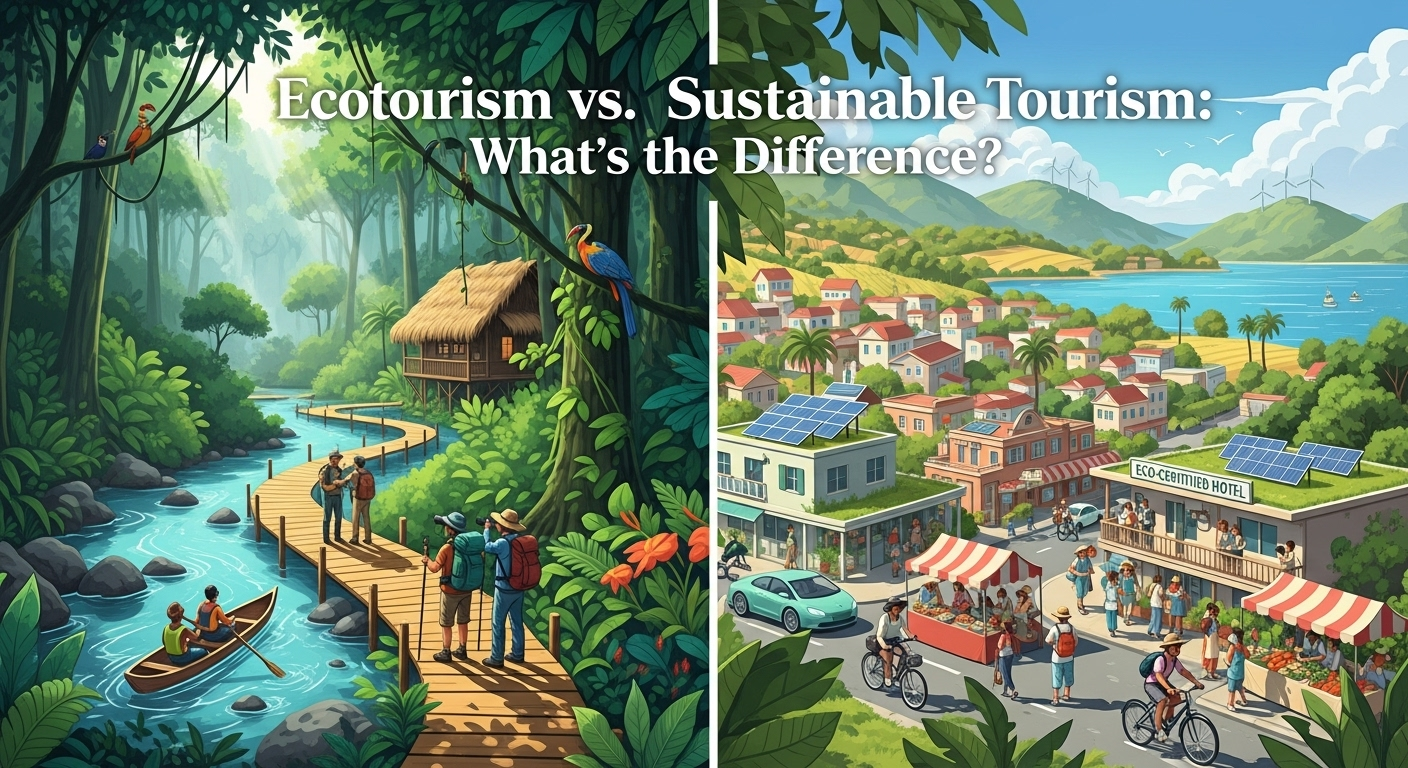
Understanding these examples will equip you to better evaluate the claims made by hotels, resorts, and tour operators. It moves beyond marketing buzzwords and allows you to analyze the substance of their operations. A company might label itself "eco-friendly," but by examining its practices, you can determine if it's genuinely contributing to sustainable principles or even meeting the high bar of ecotourism.
Examples of Sustainable Tourism
First, let's consider a hotel in a major European city like Copenhagen. This hotel is not located in a natural area, so it cannot be an ecotourism venture. However, it can be a beacon of sustainablity. It might be powered entirely by renewable energy, have a zero-waste policy in its kitchen, treat and recycle all of its greywater, and provide bicycles for guests to explore the city. Furthermore, it could prioritize hiring staff from the local community, pay them a living wage, and source all ingredients for its restaurant from organic farms within a 50-kilometer radius. This is a prime example of sustainable tourism, excelling in all three pillars, but it is not ecotourism.
Another example could be a large, all-inclusive beach resort in Mexico. Traditionally, such resorts can be environmentally and socially problematic. However, a sustainable resort would take a different approach. It might fund a local marine biology station to monitor and protect the nearby coral reef, build its own desalination plant to avoid depleting local freshwater sources, provide high-quality education and career advancement opportunities for its entirely local staff, and run a program that allows guests to visit and support a nearby Mayan village, with 100% of the tour proceeds going directly to the village council. This resort is practicing sustainable tourism, but because its primary purpose is leisure and recreation rather than conservation-focused education in a natural setting, it is not ecotourism.
Examples of Ecotourism
Now, let's look at what qualifies as ecotourism. Imagine a small-group trip to see orangutans in the rainforests of Borneo. You stay in a community-owned and operated lodge on the edge of a national park. Your guides are former loggers who are now-expert naturalists and conservationists. A significant portion of your tour cost is donated to a local NGO that works on rainforest reforestation and orangutan rehabilitation. Each day, you are educated about the fragile ecosystem, the threats of palm oil plantations, and the importance of conservation. This is a textbook example of ecotourism. It is nature-based, directly funds conservation, empowers the local community, and has a strong educational component.
Similarly, consider a kayaking tour in the whale-watching hub of Telegraph Cove, British Columbia. The tour company is certified, follows strict guidelines on how close to approach marine mammals, and uses its platform to educate guests about orca behavior and the dangers they face from pollution and vessel noise. The guides are trained marine biologists, and the company contributes a percentage of its profits to a local cetacean research organization. Guests stay in simple cabins built with sustainably harvested wood. This is also ecotourism. It meets all the criteria: responsible travel to a natural area that conserves the environment, sustains the well-being of local people, and involves interpretation and education.
Choosing Your Path: How to Be a More Responsible Traveler
Armed with a clear understanding of the ecotourism vs. sustainable tourism distinction, you can now make more deliberate and impactful travel choices. It’s not about judging one as "better" than the other; it’s about aligning your travel style and intentions with the right kind of experience. Both movements are essential for a healthier planet and a more equitable travel industry. The goal is to support genuine efforts and avoid businesses that use these terms as a marketing gimmick.
This means developing a critical eye and a curious mind. The most powerful tool a traveler has is the ability to ask questions. Don't be swayed by vague claims of being "green" or "eco." Look for evidence, transparency, and a clear commitment to the principles we've discussed. Your choices, multiplied by millions of other travelers, have the power to shape the future of the tourism industry, rewarding authentic operators and pushing others to improve.
Identifying Genuine Sustainable and Eco-friendly Options
One of the biggest challenges for conscious travelers is greenwashing. This is a deceptive marketing practice where a company spends more time and money on marketing itself as environmentally friendly than on minimizing its environmental impact. A hotel might highlight its "towel reuse program" while ignoring its massive energy consumption and food waste. To see past this, look for tangible proof.
One of the most reliable indicators is third-party certification. Independent organizations audit and certify tourism businesses that meet high standards of sustainability. Look for logos from reputable bodies such as:
- Green Globe: A global certification for sustainable tourism.
- B Corp Certification: For businesses that meet high standards of social and environmental performance, accountability, and transparency.
- Fair Trade Tourism: Focuses on fair wages, working conditions, and benefits for communities.
- Global Sustainable Tourism Council (GSTC) Criteria: While they don't certify directly, they accredit other certification bodies, so a logo from a GSTC-accredited body is a strong signal.
Questions to Ask Before You Book
Beyond certifications, your own due diligence is key. Before booking a tour or a hotel, visit their website and look for a "Sustainability" or "Our Impact" page. If you can't find one, that's a red flag. If you do, read it critically. Is it specific, or is it full of vague platitudes? Don't hesitate to email the company and ask direct questions. A genuinely sustainable or eco-certified business will be proud to share the details of their work.
Here are some powerful questions to ask:
- Economic Impact: Where does the money I spend with you go? What percentage of your staff is local, and are they employed year-round and in management positions? Do you source your supplies and food locally?
- Environmental Impact: What are your specific policies on energy, water, and waste management? Do you have programs to reduce your carbon footprint? Do you contribute directly to any conservation projects?
- Social Impact: How do you support the local community? Do you have a partnership with a local school, clinic, or community project? How do you ensure your tours respect local culture and customs?
- For Ecotours Specifically: Is there an educational component to this tour? Are your guides trained naturalists? How does this tour directly contribute to the conservation of the area we will be visiting?
Conclusion
The conversation around ecotourism vs. sustainable tourism is not about pitting two ideas against each other, but about understanding their relationship. Sustainable tourism is the foundational goal for the entire industry—a broad, inclusive vision for a type of travel that respects the planet, its people, and its economies. Ecotourism is one of its most powerful and specific expressions—a targeted form of travel that uses the wonder of the natural world to actively fund its own protection and empower its guardians.
As travelers, our role is to move beyond the labels and seek out the substance. By understanding the three pillars of sustainability and the core tenets of ecotourism, we can ask the right questions, identify authentic operators, and avoid the pitfalls of greenwashing. Whether you are choosing a certified-sustainable hotel for a city break or embarking on a once-in-a-lifetime ecotour in a remote jungle, your informed choice becomes a vote for a better kind of travel. Every trip holds the potential to be a small investment in a more beautiful, more equitable, and more enduring world.
***
Frequently Asked Questions (FAQ)
Q1: Is ecotourism always better than sustainable tourism?
A: Not at all. The "better" choice depends entirely on the context and quality of the operation. A well-executed sustainable hotel in a city that provides excellent local jobs and has a minimal environmental footprint is far better than a poorly-run "eco-lodge" that exploits its staff and fails to contribute to conservation. Ecotourism has a higher bar for its specific niche, but a high-quality sustainable tourism operation is always a positive choice.
Q2: Can a tour or hotel be both an example of ecotourism and sustainable tourism?
A: Yes, absolutely. In fact, all genuine ecotourism is, by definition, a form of sustainable tourism. Ecotourism must adhere to the three pillars of sustainability (environmental, socio-cultural, and economic) in addition to its own specific criteria of being nature-based, educational, and directly contributing to conservation. Think of sustainable tourism as the large circle and ecotourism as a smaller, more specialized circle entirely within it.
Q3: What is "greenwashing" and how can I avoid it?
A: Greenwashing is a deceptive marketing tactic where a company presents a misleadingly positive public image about its environmental or social practices. For example, a hotel might advertise its policy reação reusing towels (a minor saving) to distract from its massive water and energy consumption. To avoid it, you should:
- Look for specifics and data, not vague claims like "eco-friendly."
- Check for reputable third-party certifications (like Green Globe, B Corp, or Fair Trade Tourism).
- Ask direct questions about their economic, environmental, and social policies before you book. A transparent company will have clear, proud answers.
Q4: Does sustainable travel or ecotourism have to be expensive?
A: Not necessarily. While some high-end eco-lodges or complex tours (like gorilla trekking) can be expensive due to high conservation fees and operational costs, the principles of sustainable travel can often save you money. For instance, choosing to travel by train instead of a short-haul flight, eating at locally-owned restaurants instead of international chains, staying in a family-run guesthouse, and using public transportation are all sustainable practices that are typically more affordable. It's more about making conscious choices than about a high price tag.
***
Article Summary
The article, "Ecotourism vs. Sustainable Tourism: What’s the Difference?", provides a comprehensive analysis differentiating these two frequently confused terms in the travel industry. It establishes that sustainable tourism is a broad, overarching philosophy applicable to all forms of travel, aiming to balance environmental, socio-cultural, and economic impacts for long-term viability. This "three-pillar" approach can be applied in any setting, from urban hotels to beach resorts.
In contrast, ecotourism is a specific, niche subset of sustainable tourism. It is defined as responsible travel to natural areas that actively conserves the environment, sustains the well-being of local people, and involves a strong educational component. All true ecotourism must be sustainable, but not all sustainable tourism qualifies as ecotourism.
The article uses a comparative table, practical examples (e.g., a sustainable city hotel vs. a Bornean ecotourism lodge), and actionable advice to clarify the distinction. It warns against "greenwashing" and empowers travelers to become more responsible by looking for third-party certifications and asking tour operators and hotels critical questions about their impact. The ultimate message is that understanding this difference enables travelers to make more informed choices that align with their values and contribute positively to the destinations they visit.
