
Australia and EU strike free trade deal
Australia and EU strike free trade deal
After a prolonged negotiation period, the EU and Australia have finalized a comprehensive trade agreement, marking a significant milestone in their economic collaboration. The pact, which ended years of discussions, aims to enhance trade flows and strengthen ties amid shifting global dynamics.
Key Terms and Economic Impact
Under the terms of the agreement, more than 99% of tariffs on goods from the EU entering Australia will be eliminated, saving companies an estimated €1 billion annually in duties. Australia will eliminate tariffs on wine, sparkling wine, fruits, vegetables, and chocolates immediately, while reducing duties on cheese to zero over a three-year period.
Additionally, the agreement will ease tariffs on critical minerals imported by Australia. European car makers will benefit from Australia raising the threshold for its luxury car tax on electric vehicles, with 75% of EVs now exempt from the levy. The deal is projected to generate an additional AUD 10 billion in trade for Australia within its first year.
Security and Defense Cooperation
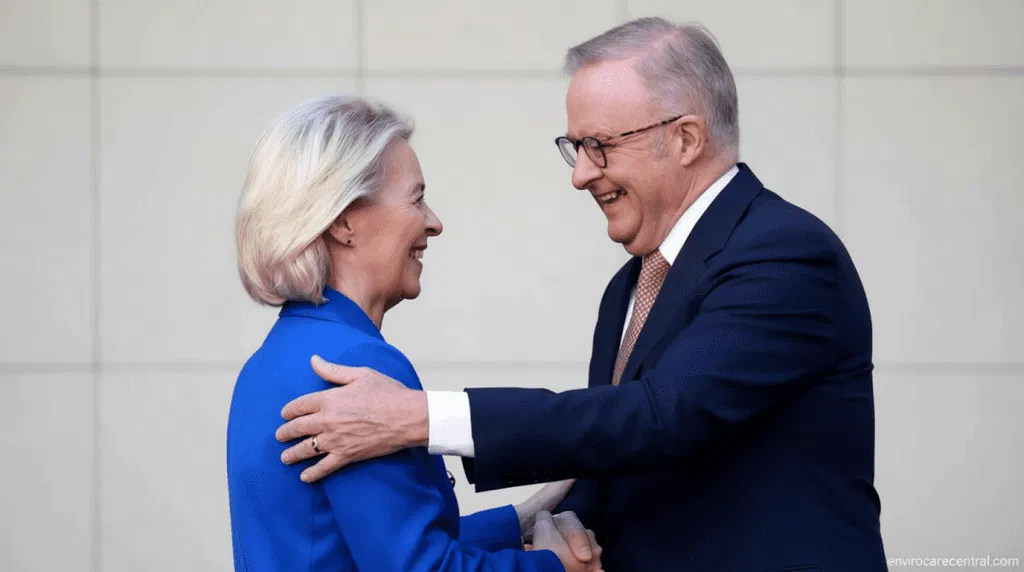
Beyond trade, the two nations have also committed to a security and defense alliance. EU President Ursula von der Leyen and Australian Prime Minister Anthony Albanese announced the pact during a ceremony held in Canberra, underscoring their shared goals.
“The EU and Australia may be geographically far apart but we couldn’t closer in terms of how we see the world,” von der Leyen said after meeting Albanese in Canberra. “With these dynamic new partnerships on security and defense, as well as trade, we are moving even closer together.”
Albanese described the deal as a “significant moment” for Australia, highlighting its role as a strategic partner. The EU remains Australia’s third-largest two-way trading partner and second-largest source of foreign investment.
Beef and Product Name Disputes
One of the major compromises involved beef exports, with the EU agreeing to two tariff rate quotas totaling 30,600 tons. Of these, 55% of grass-fed beef will enter duty-free, while the remaining 45% will face a reduced tariff of 7.5%. The transition to these rates will occur gradually over five years to safeguard EU agricultural interests.
Previous talks had stalled due to disputes over the use of protected product names like prosecco, parmesan, and feta by Australian producers. These names, recognized as Protected Designation of Origin (PDO) in the EU, are typically reserved for products originating from specific regions and produced in traditional methods.
However, Australia will retain the right to use these names for certain products, provided producers have utilized them for a minimum of five years. Australian winemakers may label their sparkling wine as ‘prosecco’ for exports, but this privilege will expire after a decade.
Implementation and Future Outlook
The local livestock sector initially sought a 50,000-ton annual tariff-free quota, as reported by Australian media. The EU will allow a quota of 25,000 tons of Australian grass-fed sheep and goat meat, phased in over seven years.
According to the European Commission, EU exports to Australia could rise by 33% in the coming decade, with motor vehicles, chemicals, and daily goods anticipated to experience the most substantial growth. The agreement will be officially sealed once ratified by the European Council and Australia’s parliament.
