
What Is a Circular Economy? A Guide to How It Works
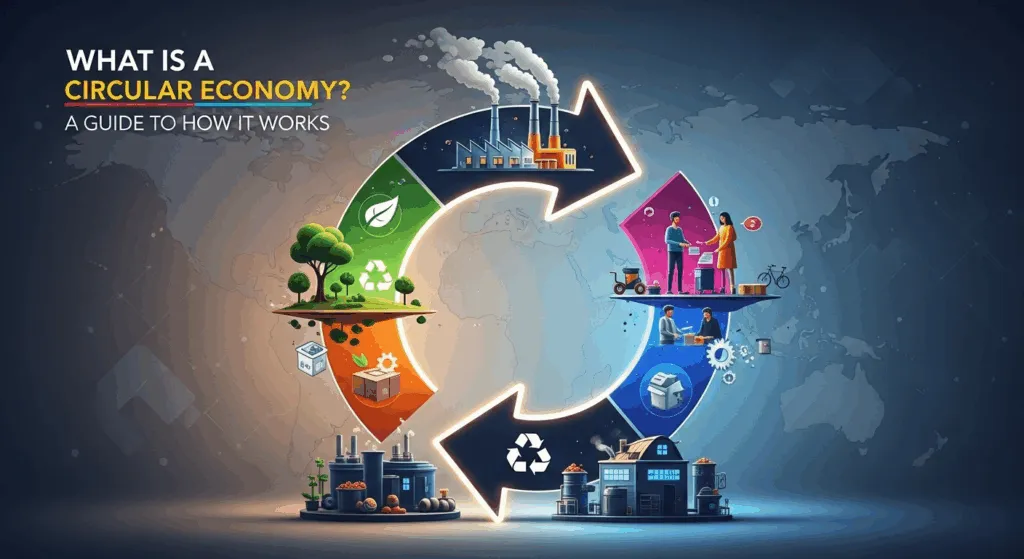
Our modern world is built on a simple, yet profoundly flawed, system: we take resources from the earth, make them into products, and then dispose of them once we're done. This linear "take-make-dispose" model has fueled incredible growth, but it's coming at an unsustainable cost to our planet and our economy. As resources dwindle and waste piles up, a powerful alternative is gaining momentum, one that a ims to redesign our entire economic system from the ground up. This guide will explore in-depth what is a circular economy and how does it work, offering a blueprint for a more resilient, regenerative, and prosperous future.
The Linear Economy: Understanding the Problem
For centuries, our global economy has operated on a linear model. This system is straightforward: we extract raw materials, manufacture products, sell them to consumers, and then, after a period of use (which is often becoming shorter and shorter), the products are thrown away as waste. Think of the single-use coffee cup, the fast-fashion t-shirt worn only a few times, or the smartphone that's rendered obsolete by a new model in just two years. This is the linear economy in action, a one-way street from extraction to landfill.
The environmental consequences of this model are staggering. It drives massive resource depletion, as we continuously mine virgin materials instead of reusing what we already have. It generates immense pollution at every stage, from the carbon emissions of extraction and manufacturing to the toxic leachate from landfills and the plastic choking our oceans. The "dispose" phase has created a global waste crisis, with mountains of trash that fail to decompose, releasing greenhouse gases and contaminating soil and water systems. In essence, the linear economy treats our planet's finite resources as if they were infinite.
From an economic perspective, the linear model is also incredibly wasteful. When a product is thrown away, all the value embedded in it—the materials, the labor, the energy, the capital—is lost forever. This creates a system that is highly vulnerable to resource price volatility and supply chain disruptions. Businesses are constantly at the mercy of fluctuating commodity markets. Furthermore, it represents a colossal missed opportunity for innovation, job creation, and new revenue streams that could be unlocked by capturing the value of so-called "waste."
The circular economy offers a radical and logical alternative to the linear model. At its core, it is a new economic framework that is restorative and regenerative by design. Instead of a straight line ending in waste, it envisions a continuous loop where resources are kept in use for as long as possible, their maximum value is extracted, and materials are recovered and regenerated at the end of their service life. It's about fundamentally rethinking how we design, produce, and consume everything, shifting our perspective from "cradle-to-grave" to "cradle-to-cradle."
This paradigm shift is guided by three core principles, famously articulated by the Ellen MacArthur Foundation, a leading authority on the subject. These principles are not just about better waste management; they are a blueprint for systemic change, aiming to build economic, natural, and social capital. They force us to move beyond the shallow idea of just recycling more and toward a deeper re-imagination of our entire industrial and biological systems.
Implementing these principles requires a profound change in mindset. It means moving from a culture of consumption to a culture of use. Products are no longer just things to be owned and discarded but are seen as vehicles for delivering a service. A company might sell "lighting" instead of light bulbs, or "mobility" instead of cars. This service-based approach incentivizes durability, repairability, and ultimate recovery, as the manufacturer retains ownership and responsibility for the product throughout its life.
Design Out Waste and Pollution
The most critical principle of the circular economy is to eliminate the very concepts of waste and pollution from the beginning. This isn't about dealing with waste after it's created; it's about proactive design that prevents it from ever arising. In a circular system, waste is a design flaw. Products are intentionally designed for durability, longevity, easy disassembly, and repair. Materials are chosen carefully, avoiding toxic substances that could harm the environment or prevent materials from being safely returned to the system.
Consider the modern smartphone. Many are glued together, making battery replacement or screen repair difficult and expensive, effectively encouraging consumers to buy a new device. In a circular design, that same smartphone would be modular. The battery, camera, and screen could be easily swapped out and upgraded by the user. The materials used would be standardized and non-toxic, allowing them to be easily recovered and channeled back into manufacturing new components. This design-led approach is the first and most important step in closing the loop.
Keep Products and Materials in Use
The second principle focuses on creating systems to keep products and materials circulating at their highest possible value. This involves a hierarchy of "loops" that prioritize value preservation. The tightest, most valuable loop is maintenance and repair, which extends a product's life in its original form. The next loop is reuse, where a product is passed on to a new user without significant modification. Further out are refurbishing (improving a product aesthetically and functionally) and remanufacturing (disassembling a product and rebuilding it with reused, repaired, and new parts).
Recycling is the final loop in this hierarchy and is considered a last resort for materials that cannot be kept in the inner loops. While far better than landfill, recycling often results in a loss of material quality (down-cycling) and requires significant energy. For example, reusing a glass bottle preserves 100% of its value and structure with minimal energy. Remanufacturing an engine block retains the core value and saves enormous amounts of energy compared to melting it down (recycling) and casting a new one. The goal is to keep products and components in the tightest, most value-retentive loops for as long as possible.
Regenerate Natural Systems
This third principle distinguishes the circular economy from a purely industrial efficiency model. It's not just about doing "less bad"; it's about actively doing "good" and improving our natural environment. This applies primarily to the biological cycle—things that can safely return to the earth, like food, cotton, or wood. Instead of depleting ecosystems, a circular economy seeks to actively regenerate them. It returns valuable biological nutrients to the soil and other ecosystems, enhancing natural capital.
A perfect example is moving from industrial agriculture, which can deplete soil health, to regenerative agriculture. This practice uses techniques like composting, cover cropping, and reduced tilling to rebuild soil organic matter, improve the water cycle, and increase biodiversity. In an urban context, this principle can be seen in action when cities collect organic food waste and turn it into high-quality compost for parks and farms, closing the nutrient loop instead of sending that waste to a landfill where it would produce methane, a potent greenhouse gas.
How a Circular Economy Works: The Butterfly Diagram
To truly understand how these principles function together, the Ellen MacArthur Foundation's "Butterfly Diagram" is an invaluable tool. It visually separates the flow of materials into two distinct cycles: the technical cycle and the biological cycle, which form the "wings" of the butterfly. This diagram masterfully illustrates how to manage different types of materials to retain maximum value.
The right wing represents the Biological Cycle, which involves the flow of renewable materials, or nutrients, that can be safely returned to the biosphere. This includes things like food, cotton, wood, and other biodegradable materials. The goal here is to regenerate living systems. Cascades in this cycle involve extracting additional value before returning the material to the earth. For instance, a wooden chair could be reused, then its wood could be turned into particleboard, and finally, the material could be used for biomass energy or composted to return nutrients to the soil.
The left wing represents the Technical Cycle, which deals with finite materials and products that cannot be composted back into nature. This includes metals, plastics, and electronics. The goal here is to keep these products and materials circulating in the economy at their highest utility and value at all times. The power of this cycle lies in its inner loops. The tightest loops, like maintain/prolong and reuse/redistribute, are the most desirable as they save the most energy and resources. The outer loops of refurbish/remanufacture are next, and the final, outermost loop is recycling, which should only be used when all other options are exhausted.
Comparing the Core Cycles in a Circular Economy
| Feature | Technical Cycle (Left Wing) | Biological Cycle (Right Wing) |
|---|---|---|
| Material Type | Finite materials (metals, plastics, synthetic polymers) | Renewable materials (food, wood, cotton, biopolymers) |
| Core Goal | Manage and circulate stocks of finite materials. Preserve value. | Manage flows of renewable nutrients. Regenerate nature. |
| Primary Processes | Maintain, Reuse, Refurbish, Remanufacture, Recycle | Composting, Anaerobic Digestion, Biogas, Nutrient Extraction |
| End of Life | Material is recovered for recycling as a last resort. | Material safely returns to the biosphere to become a resource for new growth. |
| Key Mindset | Product-as-a-Service, leasing, asset management. | Cascaded use, nutrient recovery, regenerative practices. |
| Example | A leased office printer is maintained, then refurbished, and its parts are eventually recycled. | Food scraps from a restaurant are composted to create fertilizer for a local farm. |
Real-World Examples of the Circular Economy in Action
The circular economy is not just an academic theory; it's a practical and profitable strategy that pioneering companies are already implementing across various industries. These businesses are demonstrating that sustainability and profitability are not mutually exclusive but can, in fact, reinforce one another. They serve as powerful case studies, proving that circular business models are viable, scalable, and desirable.
These examples highlight a critical element of the circular economy: innovation in business models. It often involves shifting from selling units of a product to providing a service. This change aligns the interests of the manufacturer and the customer. The manufacturer is incentivized to create a durable, efficient, and repairable product because they remain responsible for it, while the customer gets a high-quality, hassle-free experience without the burden of ownership and disposal.

Patagonia: The Worn Wear Program
The outdoor apparel company Patagonia has long been a leader in corporate responsibility. Their Worn Wear program is a textbook example of the circular principle of keeping products in use. Instead of just encouraging customers to buy new jackets, Patagonia actively encourages them to repair their existing gear. They operate the largest garment repair facility in North America and offer guides to help customers do their own fixes.
Furthermore, through Worn Wear, customers can trade in their used Patagonia clothing for store credit. The company then cleans, repairs, and resells these items on a dedicated online marketplace. This does more than just extend the life of a garment; it builds immense brand loyalty, educates consumers about the value of longevity, and creates a new revenue stream from products that would have otherwise been discarded. It's a perfect execution of the "maintain," "reuse," and "refurbish" loops.
Philips: Lighting as a Service
Philips, a global leader in lighting, has pioneered the "product-as-a-service" model. Instead of selling light bulbs or fixtures, Philips offers "Light as a Service" to commercial clients, like Amsterdam's Schiphol Airport. Under this model, the airport pays for a guaranteed level of light in its terminals, but Philips retains ownership of all the lamps and fittings.
This simple shift has profound circular implications. Since Philips owns the equipment, it's in their best interest to design lights that are highly durable, energy-efficient, and easy to maintain and upgrade. When a light fixture reaches the end of its life, Philips is responsible for taking it back, ensuring its components are remanufactured or recycled properly. This model guarantees resource recovery, reduces waste, lowers energy consumption for the client, and provides Philips with a stable, long-term revenue stream.
Interface: Carpet Tiles and Net-Works
Interface, a modular carpet tile manufacturer, has been a trailblazer in circular design for decades under its Mission Zero pledge. Their products are designed for circularity from the start. The modular nature of carpet tiles means that if one section is damaged or stained, only that small tile needs to be replaced, not the entire carpet, drastically reducing waste.
Their most inspiring initiative is a program called Net-Works. In partnership with the Zoological Society of London, Interface established a community-based supply chain in coastal areas of the Philippines and Cameroon to collect discarded fishing nets. These nets, which would otherwise pollute oceans and harm marine life, are cleaned and recycled into high-quality nylon yarn for new carpet tiles. This brilliant program cleans up the environment (regenerating natural systems), provides a new source of income for local communities, and creates a resilient supply chain for Interface, perfectly blending all three circular principles.
The Benefits and Challenges of Transitioning
Transitioning from a deeply entrenched linear system to a circular one is a monumental task, but the potential rewards are immense. The benefits extend far beyond just environmental protection, offering significant economic and social advantages that can create a more resilient and equitable global society. However, the path is not without its obstacles, and acknowledging these challenges is crucial for developing effective strategies to overcome them.
The upsides are compelling. A circular economy offers a pathway to sustainable growth that is decoupled from finite resource consumption. The key benefits include:
- Economic Gains: Creating new profit opportunities through remanufacturing and service-based models, reducing costs through lower virgin material needs, and insulating businesses from resource price volatility. The Ellen MacArthur Foundation estimates the circular economy represents a $4.5 trillion economic opportunity by 2030.
- Environmental Protection: Drastically reducing waste, pollution, and greenhouse gas emissions. A circular approach to steel, aluminum, cement, and plastics could cut emissions from these industries by 40% by 2050. It also helps preserve biodiversity by reducing pressure on natural ecosystems.
- Social Benefits: Creating new local jobs in repair, logistics, remanufacturing, and innovation. It can also increase access to goods and services through more affordable leasing and sharing models.
Despite these powerful benefits, the transition faces significant hurdles. The primary challenges include the high upfront investment required to retool factories and build reverse logistics systems, the difficulty in changing long-standing consumer habits centered on convenience and novelty, and the lack of supportive government policies and regulations that still favor the linear model. Furthermore, scaling circular models requires unprecedented levels of collaboration across entire value chains, from material suppliers to manufacturers, retailers, and waste managers. Overcoming these requires a concerted effort from businesses, policymakers, and citizens alike.
Frequently Asked Questions (FAQ)
Q1: Isn't the circular economy just a fancy word for recycling?
A: No, this is a common misconception. Recycling is a component of the circular economy, but it's considered the option of last resort. The circular economy prioritizes strategies that preserve more value, such as repair, reuse, refurbishment, and remanufacturing. Whereas recycling breaks a product down to its raw materials (often losing quality), these "inner loops" keep the product or its components intact, saving far more energy, labor, and value. The circular economy is a systemic redesign, while recycling is primarily a waste management tactic.
Q2: Is the circular economy expensive for consumers?
A: Not necessarily. While some highly durable, repairable products might have a higher initial purchase price, they often have a lower total cost of ownership over their lifetime because they last longer and don't need to be replaced. Furthermore, many circular business models, like leasing, renting, or pay-per-use, can make high-quality products more accessible and affordable. For example, it might be more affordable to subscribe to a "clothing rental service" for formal wear than to buy several expensive outfits you'll only wear once.
Q3: What can I do as an individual to support the circular economy?
A: Individuals have significant power. You can start by prioritizing buying less but buying better—choosing products that are durable and repairable. Support businesses that offer repair services or use recycled materials. Learn basic repair skills for clothing or electronics. Before throwing something away, ask if it can be repaired, donated, or sold. Participate in local sharing platforms, compost your food scraps, and properly sort your recycling. Your choices send a powerful signal to the market.
Q4: How does the circular economy relate to climate change?
A: The link is direct and powerful. Currently, 45% of global greenhouse gas emissions come from the way we make and use products and manage land. The transition to renewable energy can only address the other 55%. To tackle the remaining 45%, we must adopt a circular economy. By keeping materials in use, we avoid the immense energy consumption and emissions associated with extracting, processing, and manufacturing with virgin resources. Regenerating natural systems, like forests and soil, also acts as a vital carbon sink, drawing CO2 out of the atmosphere.
Conclusion
The circular economy is more than just an environmental strategy; it is a necessary evolution of our global economic system. It presents a compelling vision for a future where economic growth is no longer tied to resource depletion and environmental degradation. By moving away from the fragile and wasteful linear model, we can build a system that is resilient, innovative, and prosperous by design.
The journey requires a fundamental shift in how we think about value, products, and waste. It demands that we design out waste and pollution, keep products and materials in use, and actively regenerate our natural systems. While the challenges are significant, the real-world examples of companies like Patagonia, Philips, and Interface prove that this transition is not only possible but also profitable. The circular economy is our most promising blueprint for meeting the needs of the present without compromising the ability of future generations to meet their own. It is an opportunity to redesign our world for the better, one loop at a time.
***
Summary
The article, "What Is a Circular Economy? A Guide to How It Works," provides a comprehensive exploration of the circular economy as a sustainable alternative to the current "take-make-dispose" linear model. It begins by outlining the environmental and economic failures of the linear system, which leads to resource depletion, pollution, and lost value.
The core of the article defines the circular economy based on three key principles from the Ellen MacArthur Foundation: 1) Design out waste and pollution, 2) Keep products and materials in use at their highest value, and 3) Regenerate natural systems. It explains that this model is not just about recycling but involves a hierarchy of value-preserving strategies like repair, reuse, and remanufacturing.
To illustrate how it works, the piece introduces the "Butterfly Diagram," which separates material flows into a Technical Cycle (for finite materials like metals and plastics) and a Biological Cycle (for renewable materials like food and wood). Real-world examples from companies like Patagonia (repair and resale), Philips (lighting-as-a-service), and Interface (recycled carpet tiles) showcase how these principles are being successfully applied. The article also discusses the significant economic, environmental, and social benefits of this transition, while acknowledging the challenges, such as initial investment and consumer behavior change. Finally, an FAQ section addresses common questions, clarifying misconceptions and providing actionable advice for individuals, before concluding that the circular economy is an essential and optimistic blueprint for a resilient and prosperous future.
