
‘Shooting gallery’: How a US invasion of Iranian islands might unfold
Shooting gallery: How a US invasion of Iranian islands might unfold
US Marines and paratroopers deployed to capture Iranian islands in the Gulf would face a high-risk environment characterized by vulnerable supply lines and ambiguous strategic goals, according to former military officials and analysts.
The initial phase of a US invasion would involve disrupting electronic systems and radar coverage in the region, followed by a concentrated aerial bombardment. This approach aims to neutralize Iran’s defensive capabilities before ground forces are launched.
‘The US must first conduct a preparation and isolation operation,’ said Seth Krummrich, former chief of staff for US special operations in the Middle East. Electronic warfare would precede ‘preparatory strikes’ to dismantle Iran’s defensive infrastructure, he added, now serving as a senior executive at Global Guardian.
Target Islands
Kharg, the primary target, lies near Kuwait and functions as a critical hub for Iran’s oil exports, handling approximately 90% of its crude production. Abu Musa, along with two adjacent smaller islands, is at the heart of the Gulf, having been occupied by Iran’s former shah in 1971. The UAE, a US and Israel ally, asserts sovereignty over the territory.
Qeshm, the largest and most strategically significant island, poses the greatest challenge. Situated close to the mainland and near the port of Bandar Abbas, it is home to a tunnel network that Iran uses to store drones and missiles. Around 150,000 Iranians reside there, and Iran has been redirecting vessels through the Strait of Hormuz between Qeshm and Larak, its neighboring island.
Military Strategy
Historical parallels are drawn to WWII battles like Okinawa and Iwo Jima, where marines landed on Pacific islands. However, Daniel Davis, a former Army lieutenant colonel, noted that the US would likely rely on air support due to Iran’s control of the Strait of Hormuz. ‘Without regional allies providing access to strategic locations, the invasion would be significantly more challenging,’ he explained.
‘I’d wager on a helicopter insertion from the UAE,’ Davis said. ‘But Iran can read a map too, so they will be ready for it.’
The US would likely use V-22 Osprey tilt-rotor aircraft, Chinook, and Black Hawk helicopters to transport troops. These aerial assets would allow forces to bypass the Strait of Hormuz, which remains a potential bottleneck for larger amphibious ships.
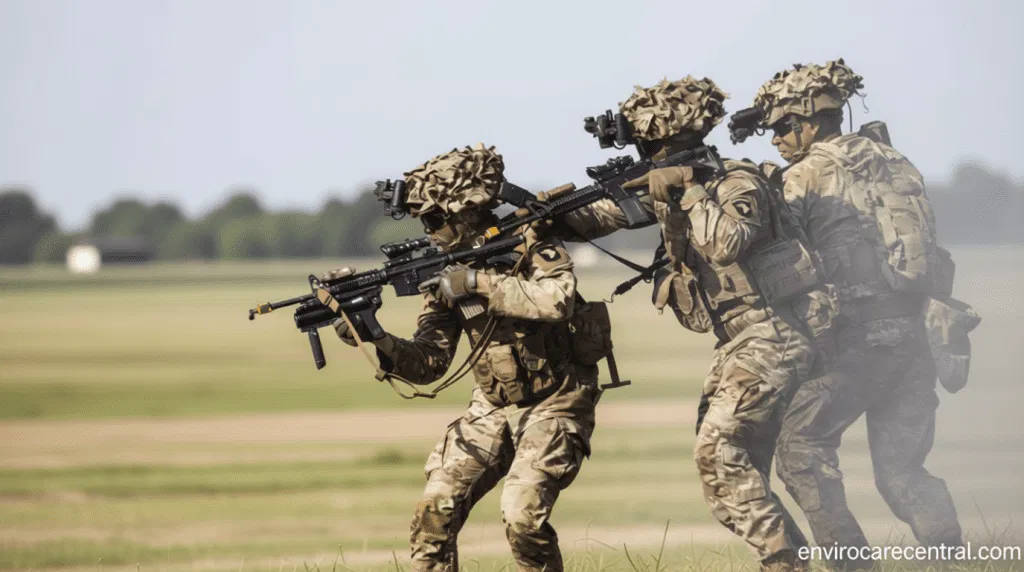
US Secretary of State Marco Rubio stated that the US can achieve its war aims without ground troops, yet a fighting force is still being sent to the region. Two marine expeditionary units, totaling around 2,500 troops, are nearing the Middle East. Additionally, 3,000 paratroopers from the 82nd Airborne Division are being mobilized.
Kalev Sepp, a former special forces officer and professor at the US Naval Postgraduate School, emphasized that the US would depend on bases in Saudi Arabia, the UAE, or Kuwait to launch the operation. ‘Without regional allies providing access to strategic locations, the invasion would be significantly more challenging,’ he explained.
MEE reported that Saudi Arabia and the UAE are gradually aligning with US and Israeli efforts against Iran. The UAE has publicly rejected any ceasefire that maintains Iran’s control of the Strait of Hormuz, while Saudi Arabia, though less vocal, has granted the US expanded access to airspace and military installations.
The most recent instance of a Western force attempting to seize nearby islands was in 1982, when Britain recaptured the Falklands from Argentina. Despite the UK’s military success, the invasion faced significant threats from the Argentinian air force during the initial landings. Iran’s islands, being closer to the mainland, are easier to defend with traditional artillery, even if they lack the same level of air support as the Falklands did in 1982.
