
Trump hints at wind down of war as US prepares to send more troops to Gulf
Trump Hints at Wind Down of War as US Prepares to Send More Troops to Gulf
As tensions persist in the Middle East, President Donald Trump suggested the possibility of reducing U.S. military engagement, despite reports of additional forces being dispatched to the region. Three amphibious assault ships, including the USS Boxer, and around 2,500 marines are set to join existing deployments, according to recent statements. This move coincides with Iran’s escalating threats and the ongoing cycle of airstrikes, drone strikes, and missile attacks that have characterized the conflict.
Iran’s recent warning to target global tourist spots has not deterred the U.S. from reinforcing its military presence. Officials indicate Washington may seek to occupy or control Kharg Island, a vital hub near the Hormuz Strait, to compel Tehran into easing restrictions on oil exports. The island, just 16 miles from Bushehr, serves as a critical node for 90% of Iran’s oil shipments and is linked to nearby offshore oil fields via pipelines.
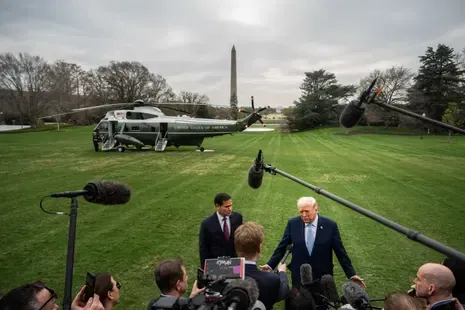
Trump’s remarks on Friday revealed conflicting signals. Initially, he dismissed the idea of a ceasefire, emphasizing the U.S.’s strategic advantage. “You don’t end a war when you’re destroying the enemy,” he told reporters at the White House. Yet, later that day, he tweeted about scaling back military efforts in the region, claiming progress had been made against Iran’s nuclear ambitions.
“Without the U.S.A., NATO IS A PAPER TIGER! They didn’t want to join the fight to stop a Nuclear Powered Iran. Now that fight is Militarily WON, with very little danger for them, they complain about the high oil prices they are forced to pay, but don’t want to help open the Strait of Hormuz, a simple military maneuver that is the single reason for the high oil prices. So easy for them to do, with so little risk. COWARDS, and we will REMEMBER!”
Amid these strategic maneuvers, the Pentagon has already activated the 31st Marine Expeditionary Unit, a force of approximately 2,200 troops. While the unit’s mission remains unspecified, the USS Boxer is set to depart three weeks earlier than planned, raising questions about its role. The administration’s shifting narratives have left allies confused, with military officials struggling to align statements on the war’s trajectory.
Recent clashes underscore the war’s unpredictability. An Iranian drone strike damaged a Kuwait refinery, while U.S. and Israeli forces targeted 16 Iranian cargo vessels in coastal areas. In Dubai, air defenses intercepted rockets during Eid al-Fitr celebrations, causing significant disruptions. Meanwhile, Israel launched strikes on Syrian government positions, just days after U.S. officials proposed leveraging Syrian forces to weaken Hezbollah in Lebanon.
Experts note that controlling Kharg Island would require overcoming substantial risks. Its proximity to Bushehr exposes American forces to Iranian drone and rocket attacks in a confined geographic area. Despite Trump’s earlier reluctance to commit ground troops, the administration maintains all options, including a potential military operation to seize the island. As oil prices climb and regional violence escalates, the situation shows no signs of easing.
