Haaland and Bellingham Set to Renew Historic England-Norway Clash
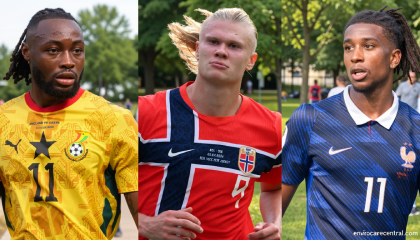
Your boys took a hell – Erling Haaland has netted seven goals across four matches at this year’s World Cup as England and Norway prepare to face each other in the quarter-finals. The fixture in Miami on Saturday represents more than just a sporting contest; it revives a rivalry that fans remember primarily for one legendary piece of sports commentary rather than on-pitch drama.
A Commentary That Echoed Through Decades
Forty-five years before Jude Bellingham and Haaland captivated audiences at the current tournament, a Norwegian commentator named Bjorge Lillelien delivered words that would achieve legendary status. In September 1981, Norway—far from the formidable side they would become—defeated an England team featuring stars such as Bryan Robson, Glenn Hoddle, Kevin Keegan, and Trevor Francis by a score of 2-1 in a World Cup qualifying match.
The victory at Ullevaal Stadium in Oslo sent shockwaves through English football. It was considered a national embarrassment for England and simultaneously hailed as Norway’s greatest triumph. Lillelien, serving as the main radio commentator for the Norwegian Broadcasting Corporation (NRK), seized the moment to deliver a message that would transcend sport and reach England’s political elite, particularly then-Prime Minister Margaret Thatcher.
The Commentary That Captured a Nation
Though reserved in his personal life, Lillelien warmed up his delivery by first criticizing Polish referee Jerzy Kacprzak, suggesting the official was “close to receiving English citizenship” due to what he perceived as excessive added time while Norway protected their lead. When the final whistle blew, Lillelien unleashed his full commentary on the airwaves.
“Lord Nelson. Lord Beaverbrook. Sir Winston Churchill. Sir Anthony Eden. Clement Atlee. Henry Cooper. Lady Diana. We have beaten all of them.”
Then came the immortal lines that would be repeated and adapted for generations:
“Maggie Thatcher. Can you hear me? We have a message for you. We have knocked your boys out of the World Cup. Maggie Thatcher. As they say in your language, in the boxing bars around Madison Square Garden New York, your boys took a hell of a beating.”
Lillelien repeated the final phrase for emphasis: “Your boys took a hell of a beating.” This closing line, in particular, has been echoed—and modified to fit various occasions—ever since that September day in 1981.
Legacy and Remembrance
Contrary to Lillelien’s assertion, England did qualify for the 1982 World Cup in Spain, though this detail mattered little at the time. Social media did not exist in 1981, so the commentary’s impact, while significant, would have been exponentially greater had it occurred in the digital age.
Lillelien, a beloved figure in Norwegian broadcasting, passed away six years later at the age of 60. He consistently maintained that his famous words were spontaneous rather than prepared. The emotional speech has been preserved through YouTube, aided by Lillelien’s fluency in English, which allowed him to switch between his native language and English when addressing Thatcher and delivering his closing remarks.
England’s defeat ranked among the most shocking results in their history, particularly because they had won the first qualifier 4-0 at Wembley Stadium a year earlier. Lillelien’s colorful commentary ensured that every English player involved in that loss would carry the memory forever.
A Man of Many Dimensions
Marius Lillelien, the commentator’s son who later became a senior broadcasting executive, shared insights in an NRK documentary: “The person we meet in the big radio moments is a man who has built himself up. Like an artist, he prepared himself for a concert. He was a very different man off air.”
Former Norway striker Egil Ostenstad, who played for Southampton and Blackburn Rovers in the Premier League, told The Times: “It was Bjorge. This was something that summarised his personality and the way he was as a commentator. I would say he’s a very untypical Norwegian. Norwegians in general try to be quite comfortable and not show too much emotion. Maybe that’s why he was so popular. He knew how to show emotions and this commentary proves it very well. He is proving that he is a well-read person to put all those things together, which, without being prepared for it, it’s a big achievement.”
Since the Premier League’s inception, England has become a favored destination for Norway’s finest footballers, with nearly 100 Norwegian players having featured in the league. Every time England and Norway meet, Lillelien’s memory is invoked with affection by most, though those who experienced the 1981 defeat still carry those painful recollections.
As Haaland and Bellingham prepare to illuminate the current tournament, they do so in the shadow of a rivalry that transcends football—a rivalry defined by one commentator’s impassioned words that continue to resonate across half a century.