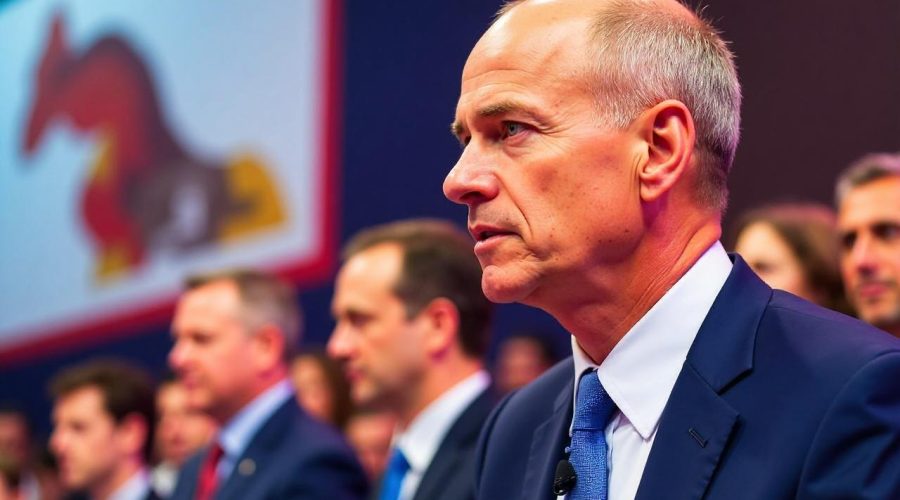
Ex-UK Political Aide Steve Hilton Promises ‘Common Sense’ Reforms for California
Ex UK political aide Steve Hilton – Steve Hilton, a former top advisor to former UK Prime Minister David Cameron, has announced his candidacy for California governor, framing his campaign as a bid to revive the state’s economic vitality and reduce bureaucratic hurdles. In an interview with BBC Radio 4’s Today programme, Hilton argued that his run is a response to what he calls a crisis of stagnation, citing 16 years of Democratic governance as the root cause of rising living costs, sluggish wages, and a decline in business confidence. His message, he said, is not tied to partisan politics but to a broader appeal for practical solutions.
Hilton’s Political Evolution
Hilton’s path to the California gubernatorial race has been as unconventional as his policies. After working on the UK Conservative Party’s “Big Society” initiative, which aimed to decentralize power to local communities, he transitioned to the United States, where he became a vocal supporter of former President Donald Trump in 2015. This shift has placed him in a unique position, as he now campaigns in a state historically aligned with progressive values.
“I was part of the Cameron government’s Big Society agenda, which focused on empowering communities through local decision-making. That experience shaped my belief in individual responsibility and government efficiency,” Hilton explained during the interview.
Despite his association with Trump, Hilton insists his platform is not a reflection of the former president’s ideology. When asked how his views align with either the Cameron-era Conservative Party or Trump’s populist movement, he stated, “I’m not a traditional Conservative or a typical Republican. I’m a political pragmatist who believes in results over labels.”
Economic Agenda and Tax Policy
Hilton’s campaign hinges on an economic plan that emphasizes tax cuts, deregulation, and streamlining state operations. He proposed setting a tax-free income threshold at the first $100,000, arguing that reducing the tax burden on individuals would stimulate spending and investment. “The quickest way to put more money into people’s pockets is for the government to take less,” he said.
The former aide also pledged to lower energy prices by expanding domestic oil production and reducing regulatory barriers. He criticized California’s reliance on imported oil, claiming environmental regulations have artificially inflated costs. “We have the resources to produce energy independently, but years of overregulation have held us back,” Hilton asserted.
“California was once the epicenter of innovation and economic dynamism. Now, it’s held back by a bloated bureaucracy that stifles progress,” he added.
Hilton further highlighted housing affordability as a key issue, proposing measures to ease the burden on residents. He argued that high costs are a direct result of overreach in state spending and overzealous regulations. “If we can simplify processes and cut waste, we can make housing more accessible for everyone,” he said.
Political Challenges and Campaign Strategy
While Hilton’s message of practicality resonates with some voters, his alignment with Trump presents a significant hurdle in a state where the former president’s popularity remains low. Hilton acknowledged this challenge but framed it as an opportunity. “Trump’s endorsement gives me credibility with Californians who are tired of Washington’s gridlock,” he claimed.
He emphasized collaboration with federal authorities as a way to achieve policy goals, particularly in energy and immigration. For instance, Hilton pointed to fuel prices as evidence of how state regulations can conflict with broader economic interests. “We can reduce energy costs by working with Washington to expand domestic production,” he said, suggesting that such cooperation would benefit both the state and national economy.
Immigration and Federal Cooperation
Immigration policy has emerged as another central issue in Hilton’s campaign. As the son of Hungarian immigrants, he positioned himself as an advocate for the “legal immigrant community,” while opposing California’s “sanctuary state” status. “I support the right of immigrants to work and contribute, but I also believe in enforcing the law,” he stated.
Hilton proposed a return to a more cooperative relationship between state and federal immigration agencies, contrasting his approach with California’s current policies. “During the Obama administration, we saw a model of collaboration that balanced enforcement with compassion,” he said. “I want to restore that balance.”
“California is a great state, but its current policies have made it harder for people to thrive. A more flexible immigration system will help create jobs and reduce crime,” he argued.
He also addressed concerns about civil liberties, noting that detentions of individuals without criminal records could be minimized through improved coordination between state and federal agencies. “When we work together, we can ensure that people are not unfairly targeted,” Hilton said.
Contrasting with Democratic Rival
His Democratic opponent, Xavier Becerra, a former cabinet secretary under President Joe Biden, has criticized Hilton’s platform as a threat to California’s progressive values. Becerra framed his campaign as a defense of the state’s identity, claiming Hilton would prioritize national interests over local needs. “Californians didn’t build this state to hand it over to a Trump loyalist who wants to reverse our progress,” Becerra said during a recent press conference.
Hilton dismissed these comparisons, calling Becerra’s characterization of him as a “Trump errand boy” overly simplistic. “I’m not here to dismantle everything the Democrats have done—I’m here to fix what’s broken,” he said. He also criticized Becerra for not addressing the root causes of economic challenges, such as high taxes and regulatory burdens.
While Becerra emphasizes the state’s diversity and social safety net, Hilton argues that these benefits come at the cost of economic efficiency. “California has a reputation as a progressive paradise, but its residents are struggling to afford basic needs. That’s not a dream—it’s a crisis,” he said.
Broader Implications of the Campaign
Hilton’s campaign reflects a growing trend in U.S. politics: the rise of pragmatic candidates who appeal to voters disillusioned with traditional party lines. By positioning himself as a unifying figure, he aims to bridge the gap between California’s liberal base and the Republican Party. However, his success will depend on whether he can translate this appeal into tangible policy outcomes.
As the November election approaches, the debate over California’s future will intensify. Hilton’s vision of a state free from bureaucratic constraints and economic stagnation has drawn both support and skepticism. His ability to balance his past with his present, and to convince voters that his “common sense” approach will deliver real change, will determine the outcome of the race.
With the state’s economy at a crossroads and political polarization on the rise, Hilton’s campaign offers a fresh perspective. Whether his message resonates with Californians or is seen as a radical departure from the state’s established values remains to be seen. But one thing is clear: his candidacy has ignited a conversation about the direction of a state often viewed as a model of progress.