Protests pass off without major incident after two nights of unrest
Protests pass off without major incident – Two nights of escalating tension in Northern Ireland have seen widespread demonstrations that have since subsided without significant disruption, following a coordinated police effort. The unrest, which began after a viral video of a knife attack in north Belfast sparked public outrage, led to sporadic clashes and targeted acts of violence across the region. However, on Thursday, the situation appeared to stabilize, with protesters gathering in smaller numbers and engaging in peaceful demonstrations.
Roots of the Unrest
The initial trigger for the disturbances was a knife attack captured on camera and swiftly shared on social media platforms. The footage, which circulated extensively, ignited a wave of anger and concern among communities, leading to spontaneous protests and confrontations. While the exact cause of the attack remains under investigation, the incident quickly became a symbol of broader tensions, particularly around issues of identity and representation.
Despite the volatility of the early days, authorities managed to contain the situation through strategic deployment of resources. The Police Service of Northern Ireland (PSNI) reported the use of extra officers, including mutual aid teams from other UK police forces, to monitor and respond to incidents. This surge in personnel was aimed at preventing the unrest from intensifying further, with a focus on both proactive patrols and rapid intervention.
Police Response and Coordination
Assistant Chief Constable Ryan Henderson, a key figure in the PSNI, emphasized that the unrest had not been orchestrated by loyalist paramilitary groups, as previously speculated. Instead, he highlighted the role of social media in amplifying the events. “At this stage, we have no evidence to suggest the violence is being coordinated by loyalist paramilitaries,” Henderson stated in a press release. “What we have observed is extensive coordination from online social media activity, some originating from within Northern Ireland and others from beyond the island of Ireland.” He further noted that the “momentum, drive, and toxicity” generated by these digital platforms were crucial in mobilizing people onto the streets.
“That momentum, that drive, that toxicity is what’s bringing people out onto the streets. It needs to stop,” Henderson added, underscoring the importance of addressing the root causes of the unrest.
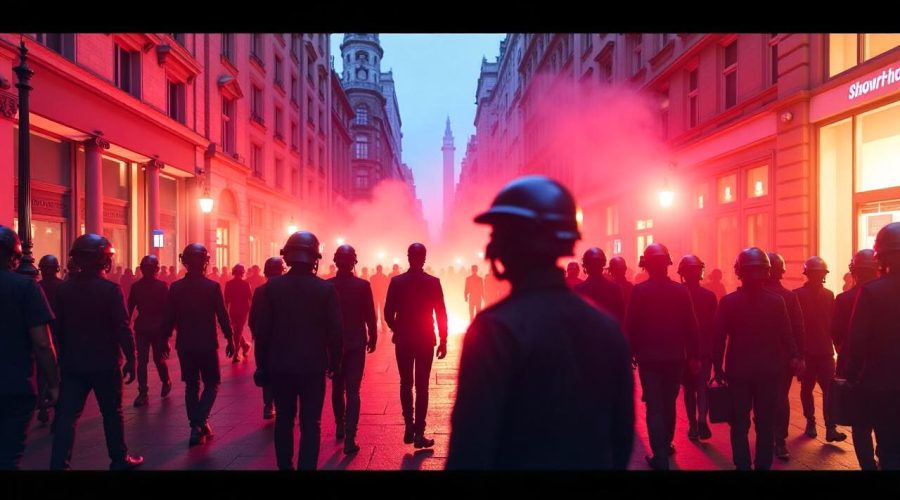
The PSNI’s response included the use of water cannon and public order dogs during Wednesday’s disturbances, particularly in areas like Glengormley and Portadown, where clashes with police were more intense. These measures helped to disperse crowds and reduce the risk of escalation. However, the actions also drew criticism from some community members, who argued that the forceful approach could be seen as disproportionate.
By Thursday, the police had increased their presence in key locations, signaling a shift toward containment rather than confrontation. Henderson warned that further deployment of resources, including additional officers and specialized equipment, would be necessary if the situation persisted. “We will be robust in bringing order to our streets,” he said, reflecting the PSNI’s determination to maintain public safety.
Community Solidarity and Racist Attacks
While the protests remained largely peaceful on Thursday, the First Minister, Michelle O’Neill, addressed the issue of racial tensions that had surfaced during the unrest. In a social media post, she acknowledged the “dangerous and disgraceful racist attacks” that had occurred across Northern Ireland over the past few days. “But what has not been recognized enough is the work being done every day by people at the heart of our communities to support one another,” she wrote, highlighting the resilience and unity of local populations.
“That spirit of solidarity represents the very best of us,” O’Neill added, emphasizing the importance of community efforts in overcoming divisions.
Throughout the two nights of unrest, the PSNI reported 12 officers sustaining injuries and 16 individuals being arrested during Wednesday’s incidents. The police also noted that homes, businesses, and vehicles had been targeted, with some areas experiencing sustained clashes. Despite these challenges, the overall level of disorder appeared to decrease, suggesting that the measures taken had been effective in curbing violence.
Analysts have pointed to the role of social media in shaping public perception and fueling the protests. The rapid spread of the knife attack footage demonstrated how digital platforms can act as catalysts for real-world events, particularly in regions with preexisting divisions. Henderson’s comments reflect a broader recognition that online activity plays a pivotal role in driving collective action, whether through shared anger or coordinated efforts.
As the protests settled into a more manageable rhythm, community leaders and activists began to focus on the underlying issues that had contributed to the unrest. While the immediate threat of violence had diminished, the debate over the role of social media in exacerbating tensions continues. The PSNI’s robust response, combined with the growing awareness of community solidarity, has created a delicate balance between maintaining order and fostering dialogue.
Looking ahead, the PSNI aims to monitor the situation closely and ensure that any residual tensions are addressed promptly. With 170 people gathering in Whiteabbey and approximately 100 individuals blocking the Newtownards Road in east Belfast, the protests on Thursday served as a reminder of the ongoing public engagement with the issues at hand. Both groups dispersed without incident, indicating a willingness to participate in peaceful demonstrations.
The aftermath of the unrest has also prompted discussions about the effectiveness of mutual aid efforts and the importance of cross-border collaboration in maintaining security. As Northern Ireland navigates this period of relative calm, the focus remains on preventing future incidents and ensuring that the voices of both supporters and critics are heard. The PSNI’s commitment to a “robust” response, alongside the community’s resilience, has set the stage for a new phase in addressing the region’s complex social dynamics.