
National Mall prayer event sparks concern about Trump administration eroding the wall between church and state
National Mall Prayer Event Sparks Debate Over Church-State Boundaries
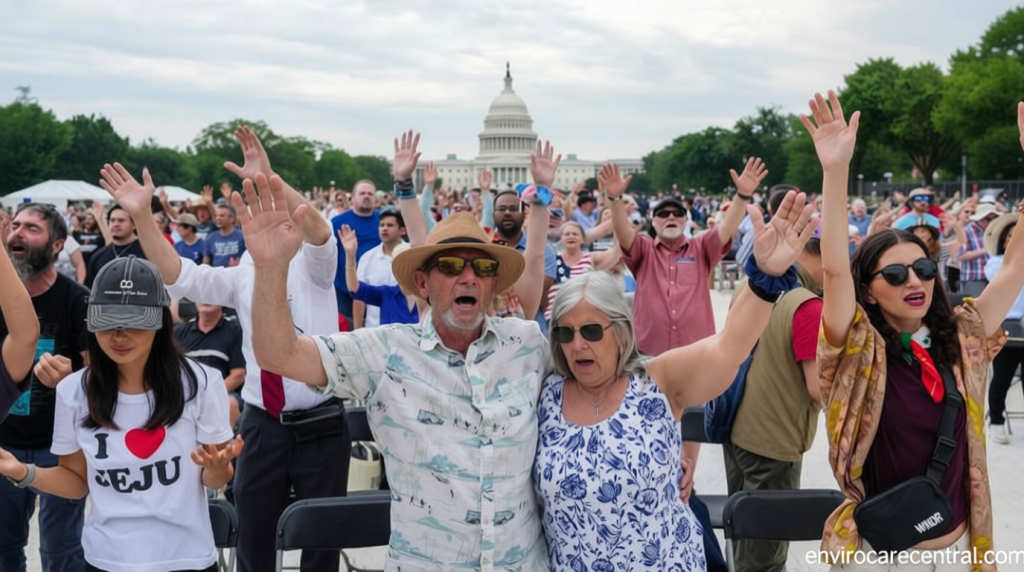
National Mall prayer event sparks concern – The National Mall prayer event sparks renewed discussions about the Trump administration’s influence on religious practices within public spaces. Held on Sunday, the gathering, supported by federal funds and private donations, drew thousands to the iconic location. Titled “Rededicate 250: A National Jubilee of Prayer, Praise, and Thanksgiving,” the event was part of a series of 250th-anniversary commemorations. It featured video messages from President Donald Trump and other officials, blending civic celebration with faith-based expression.
Religious Emphasis in a National Celebration
The National Mall, a symbol of American democracy, became a stage for faith and patriotism. Religious leaders, government figures, and musicians gathered to honor the nation’s founding, many clad in patriotic attire. The event’s design incorporated symbolic elements, such as white columns and stained-glass depictions of Founding Fathers, to create a visually resonant setting. These choices sparked questions about the balance between religious representation and secular inclusivity.
Trump’s video address included a reading from the Bible’s Book of Chronicles, followed by a prayer from House Speaker Mike Johnson and a statement from Vice President JD Vance. Vance’s remark, “we have always been a nation of prayer,” highlighted the administration’s framing of faith as integral to national identity. While the event welcomed all faiths, its emphasis on specific traditions, particularly evangelical Christianity, became a focal point for critics.
Organizational Vision and Attendance Trends
Freedom 250, a nonprofit under the National Park Foundation, organized the event to mark the nation’s 250th year of independence. The group’s senior adviser, Danielle Alvarez, described it as a moment to “reaffirm our core values” through collective worship. Despite open invitations, attendees largely represented evangelical Christians, with only one Orthodox rabbi and two Catholic bishops participating. This composition raised concerns about the event’s broader inclusivity.
Brittany Baldwin, a White House policy adviser, had previously emphasized the administration’s vision of a “Judeo-Christian” nation during a webinar. The event’s structure, including its theological themes and speaker selections, reflected this focus. For some attendees, like Vicky Kanaga from Massachusetts, the gathering symbolized a return to religious roots. Others, such as Ryan Phillips from Mississippi, saw it as a reaffirmation of faith’s role in governance.
Legal scholars have scrutinized the event’s alignment with the First Amendment. While it was permitted without a court order, critics argue it blurs the line between religious and civic activities. The administration’s promotion of specific traditions has fueled debates about the separation of church and state, with some viewing it as a strategic move to align government with a particular faith.
Constitutional Perspectives on Government Role
Andrew Koppelman, a constitutional law professor, noted that the event’s allowance does not negate its potential to challenge the Constitution’s intent. He stated, “This kind of divisive embrace of a particular religion… is bad for religion, bad for government, and bad for America.” Meanwhile, Douglas Laycock, a religion and law specialist, argued it constitutes “explicit government endorsement of religion,” specifically a denomination that may overshadow others in the public sphere.
“It is unconstitutional because it is explicit government promotion of religion, and not just religion in general, but of a fairly specific version of one particular religion,” Laycock said.
Michael Moreland, a law professor at Villanova, added that the intersection of faith and governance is not inherently problematic but requires careful framing to avoid perceived bias. The event’s legacy will depend on how it is interpreted in the context of broader religious liberty discussions.
