
Protests and defeat: Chelsea fans run out of patience with club’s billionaire American owners
Chasing Glory, Facing Discontent: Chelsea’s Owners Face Backlash
Protests and defeat – Four years into the ownership of Chelsea by the BlueCo consortium, the once-proud London club finds itself at a crossroads. What was once a symbol of financial ambition has now become a source of frustration for its supporters. The 1-0 FA Cup final loss to Manchester City on Saturday marked the culmination of a season defined by inconsistency, mismanagement, and a growing rift between the club and its loyal fanbase. For many, the defeat was more than a game—it was a stark reminder of the gap between the club’s lofty aspirations and its on-field reality.
A Billion Dollars and No Results
When Todd Boehly and his partners first took control of Chelsea in May 2022, they spoke of transforming the club into a global powerhouse. “We’re all in – 100%,” Boehly declared to fans, vowing to invest heavily in talent and secure Chelsea’s place as a dominant force in English football. Yet, as the season unfolded, those promises began to unravel. The squad that Boehly inherited has grown to an unsustainable size, with players signed on long-term contracts that now seem to prioritize financial gain over competitive edge.
Despite over $1 billion spent on transfers under Boehly’s leadership, the team has struggled to deliver. Chelsea’s latest campaign has been plagued by a lack of cohesion and leadership, with even the most ardent supporters questioning whether the new owners have truly understood the club’s identity. The FA Cup final, which ended in a heartbreakingly close loss, exposed the cracks in the team’s structure—something that had been building for months.
The Fractured Club
The disconnection between the players and fans has become palpable. During the match against Manchester City, Chelsea’s supporters were left in disbelief as their team failed to capitalize on its opportunities. The final whistle brought not celebration but quiet despair, with fans turning their backs to the pitch as they exited the stadium. This moment encapsulated a deeper issue: the club no longer feels like a shared vision but a battleground of competing interests.
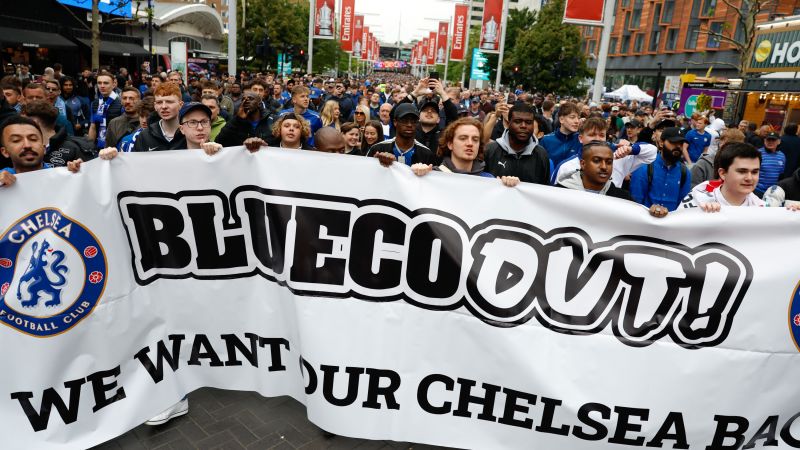
Protests against the BlueCo group were not uncommon throughout the season. The most visible demonstration came on Saturday, as fans marched along Wembley Way, waving a banner that read, “BlueCo out! We want our Chelsea back.” The rally reflected a growing sense of urgency among supporters, who have long associated the club with tradition and success. Now, they demand more than just stability—they want direction, accountability, and a return to the standards that once defined the team.
The management turmoil has only intensified the frustration. Calum McFarlane, who led the team into the FA Cup final, is acting as an interim manager, a role that has become a temporary fix for a deeper crisis. His predecessor, Enzo Maresca, had already been dismissed in January after expressing dissatisfaction with the club’s operational decisions. Before him, Liam Rosenior, a manager poached from Strasbourg, was also axed in April—highlighting the instability that has plagued Chelsea’s coaching hierarchy since the takeover.
Reports suggest Xabi Alonso may be next in line to take the helm, with the former Real Madrid and Bayer Leverkusen tactician potentially stepping in to address the ongoing issues. Alonso’s appointment would be a pivotal moment, but it also underscores the difficulty of finding a manager who can navigate the challenges left by the previous regime. The turnover in coaching staff has raised concerns about the long-term strategy of the club, with fans and analysts alike questioning whether the new owners have a clear plan for success.
From Promises to Pressure
Boehly’s initial vision was grand, but the reality has been far less inspiring. The billionaire owners promised a new era of excellence, yet Chelsea has languished in ninth place in the Premier League, missing out on Champions League qualification for the first time since the early 2000s. The team’s recent league performances have been a source of embarrassment, with seven consecutive games without a win. Even the FA Cup run, which reached the final, felt like a desperate attempt to salvage a season that has already lost its momentum.
One fan’s sentiment during the journey to the stadium captured the collective mood. “I think we’re going to get smashed,” he muttered as he boarded the tube, three hours before the match. His friend, nodding in agreement, replied, “I think you’re probably right.” The exchange, though casual, revealed the weight of expectation pressing down on the supporters. For a club with a storied history, such skepticism is rare, yet it has become the norm under Boehly’s stewardship.
While the players delivered a spirited performance in the FA Cup final, it wasn’t enough to overcome the squad’s lack of depth and experience. The strategy of signing young, high-potential players on extended contracts has backfired, leaving the team with an overgrown roster and limited leadership. This approach, which once seemed innovative, now feels like a gamble that has paid off poorly. Fans are left wondering if the club’s financial power has been squandered on short-term gains rather than long-term sustainability.
The discontent isn’t limited to the field. Inside the stadium, the atmosphere was a mix of hope and doubt as supporters sang familiar anthems, a tradition that once united the club. Yet, the players’ response was just a fleeting moment of inspiration, overshadowed by the glaring shortcomings in their performance. The match against Manchester City, in particular, highlighted the disconnect—fans were eager for a fight, but the team lacked the quality to deliver.
As the season draws to a close, the pressure on Boehly’s administration has reached a boiling point. The protests, the failed campaigns, and the managerial upheaval all point to a club in crisis. For a team that once dominated European and domestic competitions, the current state feels like a regression. The question now is whether the new owners will recognize their mistakes and make the necessary changes—or if Chelsea’s golden era is slipping through their fingers.
What began as a bold transformation has evolved into a test of patience. The BlueCo consortium, once seen as a beacon of financial stability, now faces the challenge of rebuilding trust. With the upcoming transfer window and the search for a permanent manager, there is still a chance to course-correct. But for now, the stadium echoes with the sound of frustration, as fans demand a return to the excellence that once made Chelsea a household name. The road to redemption may be long, but it starts with acknowledging the problems—and taking action to fix them.
